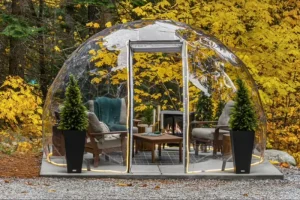
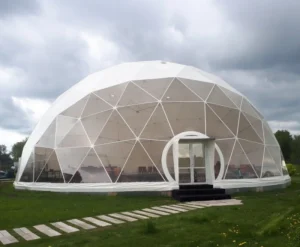
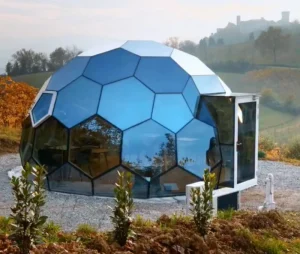
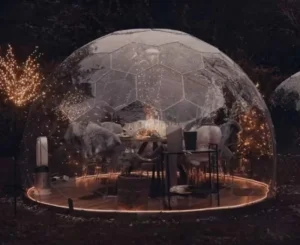
Under normal design, reasonable use, and regular maintenance, the lifespan of a geodesic dome is typically between 8 and 20 years.
With high-quality structural materials, design tailored to the local climate, and long-term fixed installation, some commercial geodesic domes can actually last for more than 25 years.
Introduction
When first encountering a geodesic dome, whether you are a campsite owner, a project investor, or someone planning a long-term outdoor space, you will almost instinctively ask:
“How many years can this dome last?”
This question itself is not wrong, but in actual projects, we find that it is often not specific enough. Because a geodesic dome is not like a disposable product; it is more like a “long-term usable space system.”
Some people use it for weekend camping experiences, some use it as a year-round accommodation unit, and others use it directly as a semi-permanent building. In these completely different usage scenarios, the word “lifespan” itself means different things.
Therefore, instead of just giving a number, it’s better to explain this question step by step from the perspective of real-world use.
The Four Pillars Affecting Dome Lifespan
The structural life cycle of a geodesic dome is a comprehensive interplay of materials, environment, and maintenance. Understanding the following four key factors is fundamental to ensuring the durability of your dome.
1. Materials
Frame Materials: The Core of Structural Lifespan
The stability of a geodesic dome stems from the overall force system formed by the triangular structure, and the quality of the materials determines whether this structure can maintain its performance in the long term.
In long-term outdoor projects, the frame is usually the most durable part of the entire system, and the lifespan differences between different materials are mainly reflected in their corrosion resistance and usage scenarios.
Hot-dip galvanized steel pipes
This is the most common choice for long-term fixed installation domes, possessing good corrosion resistance and suitable for year-round outdoor use. Under normal design and usage conditions, the lifespan can generally reach 20–30 years, and it is commonly used in campsites, commercial projects, and semi-permanent projects.
Aluminum alloy structure
Lightweight and rust-resistant, suitable for projects that require frequent disassembly and assembly or have high aesthetic requirements. Under reasonable use, the lifespan is usually between 15 and 25 years, with a greater emphasis on design precision and structural calculations. Standard Coated Steel Pipes
Lower initial cost, but limited corrosion resistance. More prone to rusting in long-term outdoor environments, with a typical lifespan of 5–10 years, making them more suitable for short-term or temporary projects.
In most long-term projects, the frame itself is not the first part to show signs of aging.
Covering Materials: The part that shows age first
Compared to the structure, the covering material is directly exposed to sunlight, rain, and temperature fluctuations, making it more susceptible to aging. Therefore, it often determines people’s intuitive perception of whether the dome “looks old.”
PVC Architectural Membrane
Good waterproof and UV resistance, suitable for commercial and long-term projects. A reasonable lifespan is approximately 10–15 years, and it can be replaced after aging without affecting the structure.
High-Strength Polyester Fabric (with coating)
Lightweight and easy to install, more suitable for medium-to-short-term use, with a typical lifespan of around 5–8 years.
Transparent or Translucent PVC
Often used in viewing and accommodation domes, requiring higher UV protection. The lifespan is generally 8–12 years, and the covering can be replaced later to extend its use.
From a long-term perspective, the covering material itself is a maintainable and replaceable part, not a factor that determines the overall obsolescence of the dome.
2. Usage and Design
In many projects, geodesic domes of the same specifications and materials show completely different conditions after a few years of use.
The key reason for this difference is often not the product itself, but the initial intended use.
The Essential Difference Between Temporary Use and Long-Term Installation
Domes used for exhibitions, festivals, or short-term events, although frequently erected, are only exposed to the outdoor environment for a limited time each year.
The material consumption in such projects is relatively controllable, and lifespan is usually not a major issue.
However, domes used for long-term fixed installations such as campsites, restaurants, or exhibition halls need to withstand wind, rain, sunlight, and temperature changes throughout the year.
If a lightweight dome originally designed for short-term events is used as a long-term building, a significantly shortened lifespan is almost inevitable.
Considering “How Long Will It Be Used?” During the Design Phase
For truly mature dome projects, the lifespan is not something that “happens” later, but is clearly planned during the design phase.
Professional dome manufacturers usually consider the expected lifespan of the project from the outset, whether it’s 5 years, 10 years, or longer. At the same time, wind and snow load calculations will be performed based on actual conditions, and space will be reserved for future maintenance and replacement of the covering materials.
When these factors are fully considered during the design phase, the dome will naturally be more likely to meet or even exceed its original expected lifespan during use.
3. Climate and Environment
In actual projects, the following situation is often observed:
The same geodesic dome, when used in different regions, can have vastly different conditions.
In areas with relatively dry and mild climates, some domes remain in good condition even after 15 years of use;
However, in areas with strong ultraviolet radiation, frequent wind and snow, or high humidity, renovation or replacement of the covering system may be required after 8–10 years.
This difference mainly stems from the long-term impact of environmental factors.
Strong ultraviolet radiation accelerates the aging and fading of covering materials, while high humidity or coastal environments place higher demands on metal corrosion protection;
Areas with strong winds and heavy snow also require significantly higher structural strength and node design.
Therefore, when evaluating the lifespan of a geodesic dome, it must be considered in conjunction with the specific usage area, and not just based on the product parameters themselves.
4. Post-Installation Maintenance
Geodesic domes are not something that can be completely ignored after construction, but their maintenance costs are often not as high as imagined.
In long-term use projects, some very basic maintenance actions can have a significant impact on lifespan.
For example, regularly checking for loose connections, promptly clearing snow and water accumulation to avoid prolonged localized stress;
Or regularly cleaning the covering surface to reduce the erosion of materials by dust and pollutants.
When the covering material shows significant aging, choosing to replace the membrane instead of completely scrapping the dome is also a common practice to extend its service life.
With proper maintenance, many geodesic dome projects ultimately have a longer actual service life than initially expected.

How to Choose a Geodesic Dome Tent That Meets Your Lifespan Needs
Once the usage scenario and budget are clear, choosing a dome tent can be approached from a different perspective—
Instead of choosing materials first, think about how long you want it to last.
Different lifespan expectations correspond to completely different configuration priorities.
Commercial Leasing or Events and Exhibitions (Short-term, High Turnover)
These projects usually prioritize flexibility, requiring frequent disassembly, transportation, and reuse of the dome. A more suitable solution is to use an aluminum alloy frame with a relatively lightweight PVC covering (approximately 750g/㎡).
Aluminum alloy structures are lightweight and easy to install, and the frame itself can last for more than 20 years.
It should be noted that with frequent folding and handling, the covering will wear out faster and usually needs to be replaced every 5 years or so.
However, in rental and exhibition scenarios, this configuration often yields a higher overall return on investment.
Luxury Glamping Hotels or Medium-to-Long-Term Operating Projects
If the dome needs to be used continuously for 8–15 years and will be exposed to wind, snow, sunlight, and temperature changes for extended periods, then stability and comfort become core requirements.
These types of projects are more suitable for hot-dip galvanized steel frames, paired with thick PVDF-coated PVC coverings (950g/㎡ or 1100g/㎡).
The steel structure provides long-term safety assurance, while the heavy-duty PVDF fabric performs more stably in terms of UV resistance and aging resistance, extending the covering replacement cycle to 10–15 years.
In actual operation, the maintenance focus of these domes is more on node inspection and internal moisture control, rather than frequent material replacement.
Permanent Residences or Garden Greenhouses (Longest Lifespan Expectation)
If your goal is a dome space with a lifespan of over 30 years and minimal maintenance frequency, then its positioning is close to that of a permanent building.
These types of projects usually choose high-strength galvanized steel structures or concrete foundations, paired with rigid panels such as glass or polycarbonate.
Compared to soft coverings, glass or PC panels require almost no periodic replacement and are more suitable for long-term fixed use.
However, this solution usually requires stricter building permits and has higher requirements for foundations, sealing, and drainage systems, making it more suitable for projects with clear long-term plans.
Gaxdome: Designing Dome Systems from a Lifespan Perspective
As a professional manufacturer of dome tents and marquees, Gaxdome consistently follows a core principle in product design:
Permanent frame + replaceable covering system. Our outdoor commercial geodesic domes uniformly utilize high-quality Q235 galvanized steel pipes, which are powder-coated or hot-dip galvanized according to project requirements, giving the frame a design lifespan of nearly 30 years in outdoor environments.
In terms of structural details, we have specifically reinforced the stability of the connection nodes (hubs), using high-strength aluminum alloy nodes and anti-loosening connection solutions to withstand the effects of long-term wind loads and temperature changes.
For the covering system, Gaxdome offers a variety of PVC and PVDF coated options ranging from 850g/㎡ to 1100g/㎡.
Customers can choose the most suitable configuration based on local UV intensity and expected lifespan, and replace the covering at a relatively controllable cost after its lifecycle ends, ensuring the dome structure remains in excellent condition.
Summary
A geodesic dome is not a “disposable” temporary structure, but a long-term, sustainable investment.
Its lifespan is not defined by a single number, but by a lifecycle composed of an indestructible frame (30-50 years) and replaceable coverings (5-20 years).
By understanding the limitations of the materials, adapting to environmental challenges, and committing to regular maintenance, you can easily ensure your dome structure lasts for decades and continues to serve you in optimal condition, whether as a unique residence or a profitable commercial space.