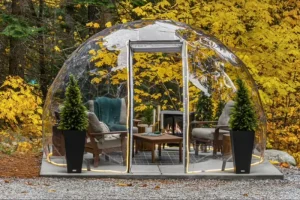
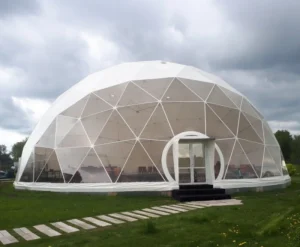
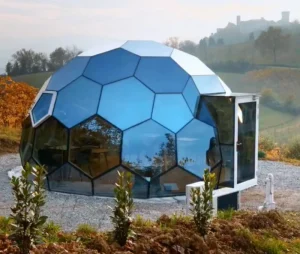
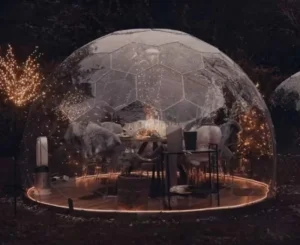
The avarage cost of a geodesic dome varies widely, often depending on size, material, customization, and interior features. Small private domes start around $2,000, while large domes for commercial events or exhibitions can exceed $100,000.
There’s no single standard price for a dome tent, as the cost includes not only the frame and membrane, but also design, transportation, installation, and additional features. Understanding these factors will help you more clearly budget and select the right supply options.
If you’re new to a geodesic dome, you’ll likely be struck by its appearance: its strong geometric design, airy feel, excellent wind and snow performance, and the ability to project lights at night—a truly captivating event space. However, when it comes to price, the price range can range from a few thousand to hundreds of thousands of dollars, a staggering difference.
The following section will provide a detailed explanation of the cost of a geodesic dome tent, analyzing different sizes.
Average Dome Cost Range by Diameter
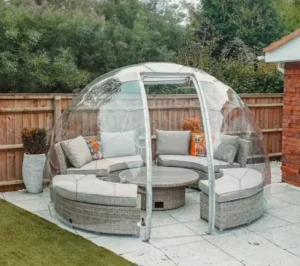
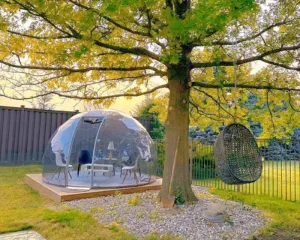
Small Dome (3–6 meters in diameter)
Recommended Uses: Private leisure, family camping, meditation space, backyard greenhouse, etc.
Average Price: $2,000–$8,000 (basic frame + tent).
Features: Relatively simple structure and easy installation, typically only includes basic doors, windows, and ventilation; if flooring, insulation lining, or elaborate doors and windows are added, the budget will increase.
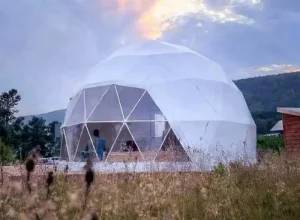
Medium Dome (6–10 meters in diameter)
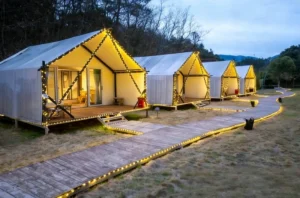
Recommended Uses: Glamping, small events, cafes/yoga studios, model displays, etc.
Average Price: $8,000–$30,000.
Features: More spacious, with optional insulation, lining, wood flooring, glass doors, and landscape windows; accessories and workmanship begin to become major price tags.
Large Dome (diameter ≥10 meters)
Recommended Applications: Convention and Exhibition Halls, Main Venues for Brand Launches, Commercial Showrooms, Eco-Hotels, Park Installations, etc.
Average Price: $30,000–$100,000+
Features: Involves higher structural safety requirements and engineering coordination, generally requires a professional team for design, installation, and commissioning; high customization can significantly increase the budget.
Buy or Rent?
Rent: For short-term events (1–7 days), prioritize quick setup and recovery, and want to hand over transportation and installation to a service provider.
Buy: For long-term operations (campsites/exhibition halls/attraction installations), frequent reuse, and the desire for in-depth customization tailored to your brand’s style.

What goes into the cost of a dome tent?
1) Size and Span
Diameter and height are the primary factors determining a dome’s cost. Larger domes require more material and a greater number of joints, which increases the difficulty of fabrication and installation.
A larger span not only increases material costs but also means the structure must be stronger to withstand the elements, such as wind and snow. Therefore, the larger the dome, the higher the overall budget.
2) Material Selection
Material selection has a direct impact on cost. For the frame, while aluminum alloy is more expensive per unit, it is lightweight, corrosion-resistant, and easier to transport and install.
Galvanized steel pipes, while inexpensive and strong, are heavy and require additional corrosion protection and maintenance. For large domes or those intended for year-round use, this weight and maintenance cost must also be factored into the budget.
The skin or outer covering material is also crucial.
- PVC membrane is the most common choice, offering excellent weather resistance and flame retardancy, and can be designed in transparent or translucent forms.
- Polycarbonate sheets offer strong impact resistance and excellent light transmission, but are complex to install and costly.
- Glass systems offer the best visual and soundproofing performance, but they place extremely high demands on the structure and foundation, significantly increasing costs.
Even for the same PVC, differences in weight, coating, flame retardancy, and surface treatment can result in significant price differences.
3) Design and Customization
The design and degree of customization of a dome significantly impact its price. Standard triangular grid structures are economical and practical, while designs such as irregular openings, specialized grids, or external corridors significantly increase processing and construction costs.
The number and specifications of doors and windows, skylights, projections, ventilation ceilings, and connection methods to existing buildings all require additional design and engineering considerations. Custom colors, interior lining styles, exterior facade printing, and nighttime lighting and projection systems can further increase the budget, but can also create a unique branded visual effect.
4) Interior Configuration and Functional Systems
The interior configuration directly determines the comfort and practicality of the dome. Insulation, acoustic lining, and thermal insulation are particularly important for camps with long-term use or seasonal operations. The choice of flooring system can also increase costs. From simple wooden platforms to modular load-bearing platforms or moisture-resistant flooring, the price per square meter can vary significantly.
Plumbing, electrical, and HVAC systems, such as lighting, sockets, distribution boxes, low-voltage wiring, and air conditioning or floor heating connections, also significantly increase costs. The more comprehensive the configuration, the better the user experience, but the budget will also increase accordingly.
5) Engineering Strength and Compliance (Overlooked but Costly)
Dome tents must meet wind and snow loads, fire ratings, and safety regulations. Wind and snow standards in different regions directly determine pole wall thickness and joint strength.
Fire protection requirements, including material grade, number of escape doors, and evacuation width, also incur additional costs. Furthermore, some regions require temporary construction approvals or insurance installation, costs that are often overlooked but are part of the overall cost.
6) Suppliers and Services
The geodesic dome supplier brand and service level are also important factors in pricing. Established brands generally indicate consistent quality, comprehensive warranties, and effective construction management, all of which are reflected in the price.
Services range from simply providing the product to a one-stop service including design, transportation, installation, training, and after-sales service. While a more comprehensive service package may increase the total price, it also reduces project risk.
7) Logistics and Installation
Transportation and installation are also significant components of the dome’s cost. Intercontinental or long-distance inland transportation can account for 10%–20% or even more of the total cost.
The installation of large domes often requires specialized lifting and overhead work. Labor costs can be further increased if site conditions are limited, construction time is limited, or there are noise restrictions.
The foundation and anchoring methods, including anchor bolts, chemical anchors, counterweights, or temporary ground beams, are priced separately based on site conditions, impacting the overall budget.
Why are dome tents so expensive?
The core reason for dome tents’ high cost lies in their non-standard design, high-precision manufacturing, premium materials, and niche market appeal. Compared to ordinary tents, dome structures are more complex, require higher precision machining, utilize higher-grade aluminum, steel, and membrane materials, and require multiple surface treatments. Furthermore, dome tents are difficult to install, require extensive project-based customization, and lack the advantages of large-scale production, resulting in significantly higher overall costs than ordinary tents.
Non-standard Production
Dome tents are not constructed using the conventional “rectangular plate + standard columns” principle. Every triangular facet and node requires precise calculation and cutting. The large number of parts, diverse sizes, and stringent quality control requirements significantly increase labor and time costs on the manufacturing side.
High-Precision Geometry and Structure
The strength of geodesics derives from their “overall geometry.” Any error in a node impacts overall stability. Design, mold making, processing, and trial assembly all require a higher level of precision and experience—an invisible investment not seen in simple tents. Materials and surface treatments are more sophisticated.
To achieve a balance between lightweight and strength, aircraft-grade aluminum, high-strength steel, and high-performance membranes are often used, along with treatments such as anodizing, hot-dip galvanizing, and high-weather-resistant coatings. None of these features are cheap.
Niche market, difficult to scale
Dome tents are still a relatively niche and project-based product, making it difficult to achieve cost reduction through scale like standard tents or storage tents. Smaller batches result in higher unit prices; this is an objective rule.

How does it differ from “ordinary tents”?
Structure: Conventional A-shaped tents and exhibition tents primarily utilize linear members and fabric; domes are multi-directionally loaded spatial lattice shells, offering improved wind and snow resistance.
Visual Effect: Domes offer a more immersive and geometrically robust design, making them suitable for projection, lighting, and branding installations.
Cost Structure: The high number of nodes, high machining precision, and demanding installation requirements make them inherently more expensive than ordinary tents.
Analysis Average Cost of a Geodesic Dome Tents
To give you a clearer understanding of the average cost of geodesic dome tents, we’ll provide pricing for 8m and 12m diameter geodesic dome tents. These are for illustrative purposes only and provide a sense of range. Prices vary significantly across regions and configurations. Please contact us for the latest pricing information.
8 m diameterboutique campsite/small event
- Basic kit (aluminum frame + PVC film): $9,500
- Insulation lining (entire dome): $2,000
- Glass door + two landscape windows: $1,200
- Wooden platform/modular floor: $2,500
- HVAC/electrical prep and plumbing: $600
- Domestic transportation (example): $800
- Installation labor (2-day team): $2,000
Total: $18,600
12 m diameter brand event/showroom
- Basic kit (thickened poles + highly flame-retardant film): $34,000
- Reinforced snow and wind protection kit (high wind/cold areas): $3,800
- Double door vestibule + partial glazing system: $4,200
- High-efficiency insulation lining: $6,500
- Modular load-bearing floor: $7,800
- Basic lighting + Power Distribution: $3,000
- HVAC Equipment Rental (Promotional Period): $5,500
- Ocean/Inland Transportation: $6,000
- Professional Installation (4–5 days): $6,500
Total: $77,300
Summary
The average price of a geodesic dome is “expensive and volatile” because it is essentially a highly precise spatial structure system, not just a temporary shelter. Size, materials, customization, internal systems, engineering compliance, and the depth of service all contribute to its ultimate value.
If you are evaluating a purchase or lease, don’t just focus on the total price. A more sensible approach is to request a detailed, project-based list from the supplier, breaking down both the “visible materials” and the “invisible engineering and services” components. Then, based on your site and operational needs, you can make trade-offs and optimize them. This way, you won’t just end up with a “dome,” but a reliable, sustainable spatial solution.
If needed, I can quickly provide you with a customized configuration and budget draft based on your site size, climate zone, duration of use, and budget, making communication more efficient. You can contact us to get a detailed quotation.