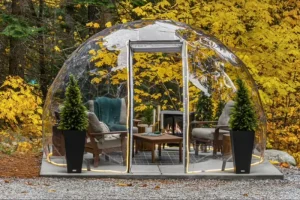
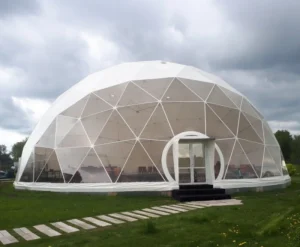
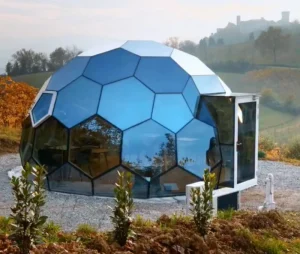
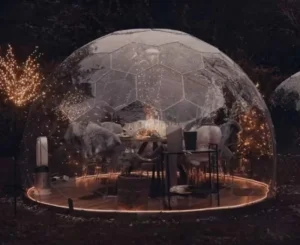
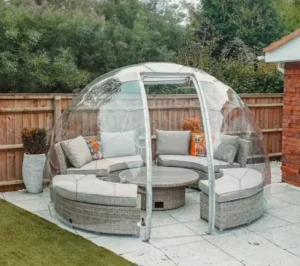
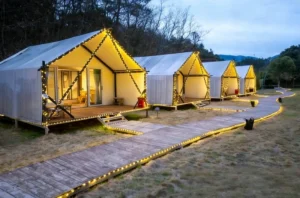
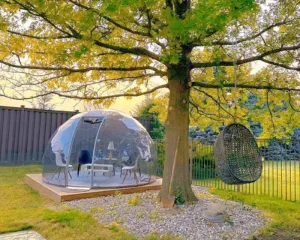
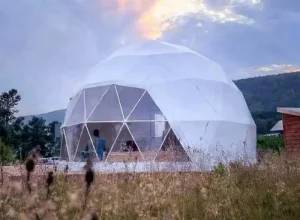
A geodesic dome is a spherical or hemispherical structure composed of numerous triangular units. It distributes forces geometrically throughout the entire structure, rather than concentrating them in specific areas. Therefore, it achieves excellent stability and strength without requiring excessive materials.
Because of this simple yet stable design, and its departure from traditional architectural forms, it is now very popular in commercial, cultural tourism, public spaces, and long-term outdoor projects.
What does “Geodesic” mean in Geodesic Dome?
The word “Geodesic” originated in geometry, not architecture.
In geometric terms, it represents the shortest path between two points on a sphere—the most natural and efficient route. When this concept is applied to architectural structures, it translates into an efficient way of distributing forces—allowing each structural member to work along the most reasonable force transmission path, rather than bearing unnecessary burdens.
Therefore, a geodesic dome is not simply a circular structure, but rather a combination of many interconnected triangles. This design, seemingly complex, allows forces to flow naturally within the structure, reducing stress concentration and resulting in better stability and safety.
How is the structure of a Geodesic Dome composed?
If you walk into a geodesic dome and look up from the inside, you will find that you see almost none of the thick beams or columns commonly found in traditional buildings.
Instead, you’ll see a spatial grid structure composed of triangles. Each structural member forms a mutually supportive relationship with other members, rather than bearing weight in isolation. It is this “working together” approach that prevents wind pressure, snow load, and the structure’s own weight from concentrating at a single point, but instead distributes them evenly across the entire dome surface.
Therefore, many dome buildings can be completely free of internal columns, resulting in spacious, flexible interiors with greater design freedom. Whether it’s a small 5-meter experiential space or a large commercial or public building over 30 meters, they essentially follow the same structural logic, differing only in scale and function.
Why does a Geodesic Dome look lightweight yet is very stable?
This is probably the most common question many people have when they first see a dome structure: why is this seemingly simple structure considered so stable?
It’s not its weight that makes it safe, but rather its precise and efficient structural logic that provides stability. The triangle is widely recognized as the most stable geometric shape, and when a large number of triangles are combined into a near-spherical structure, the structure’s resistance to deformation is multiplied.
When strong winds arrive, the wind force naturally slides along the curved surface instead of directly impacting it; in snowy regions, snow doesn’t accumulate in one area but is dispersed or slides off naturally. Because of this, Geodesic Domes are often used in areas with complex weather conditions and high reliability requirements, not only for short-term construction but often for long-term or even semi-permanent use.

What materials are typically used for Geodesic Domes?
For a geodesic dome to be durable and long-lasting, it requires not only a stable structural design but also a sturdy frame and durable covering materials.
For the framework, galvanized steel and aluminum alloy are the most common. The former offers high strength and moderate cost, while the latter is lighter and more corrosion-resistant, suitable for long-term outdoor environments and projects sensitive to maintenance costs.
Covering materials are even more flexible, including PVC tarpaulin, composite cladding panels with insulation, transparent PC panels, or even glass structures. Different materials not only affect the visual appearance but also directly impact the service life and applicable scenarios. Generally, PVC coverings can be used reliably for 5–8 years, while more robust composite or glass coverings are more suitable for long-term or semi-permanent buildings.
What scenarios are Geodesic Domes typically used in?
You may have seen geodesic dome structures in luxury glamping sites or cultural tourism projects, but their applications extend far beyond these examples; they can be used in a wide variety of settings.
Today, Geodesic Domes are widely used in glamping (luxury camping), unique dining spaces, brand showrooms, event and exhibition spaces, and immersive commercial environments. At the same time, they are also used for swimming pool covers, sports field protective structures, industrial warehousing, and in research and education fields.
They also demonstrate high adaptability in emergency relief, military temporary structures, and post-disaster temporary housing. Their ability to span so many industries is due to their combination of spatial efficiency, structural reliability, construction flexibility, and strong visual recognition, which positively impacts commercial communication and project image.
Are Geodesic Domes suitable for commercial and long-term use?
This is a question that many investors considering purchasing a geodesic dome are concerned about; besides its aesthetic appeal, they are more interested in its durability.
In fact, with proper design, materials, and foundation planning, a Geodesic Dome can be used as a semi-permanent or even long-term structure. It can operate stably for many years and can be disassembled, relocated, or functionally expanded when needed, perfectly matching the needs of modern commercial projects for rapid deployment and flexible adjustments.
If you want to reduce the pressure of the long construction cycles and high costs of traditional buildings, this structure is often a more flexible and practical option.

How energy-efficient is a Geodesic Dome?
From its external form, the geodesic dome possesses inherent advantages.
A sphere is one of the shapes with the smallest surface area for a given volume, meaning slower heat exchange and lower energy consumption. It’s more effective at retaining heat in winter and reduces cooling loss in hot environments.
The airflow within the dome is more natural, allowing for easier air circulation. Combined with reasonable ventilation design and natural lighting, many dome buildings actually consume less energy than traditional buildings in practical use. This is becoming increasingly important in today’s environment that emphasizes energy saving and environmental protection.
How is a Geodesic Dome different from traditional buildings?
Besides the most obvious difference in shape, the main difference between a geodesic dome and traditional buildings is that their construction principles are fundamentally different.
Traditional buildings rely more on material stacking and thickness for a sense of security, while Geodesic Domes rely on sound mechanical design, allowing the structure to work according to the principles of force distribution. This saves materials, improves overall integrity and spatial continuity, and results in faster construction and greater flexibility.
Of course, it’s not meant to replace all buildings, but rather to provide a smarter and more efficient option in suitable scenarios.
Common Geodesic Dome Size Ranges
In actual projects, the size is often directly related to the purpose.
Domes with a diameter of 5–8 meters are often used for private activity spaces, small experience areas, or unique accommodations; 10–15 meters are more suitable for commercial reception, dining spaces, small exhibitions, or event spaces; 18–30 meters and above are typically used for public purposes, industrial functions, or large commercial projects.
The larger the size, the higher the requirements for design, foundation, and materials, but the logic remains the same. With a reasonable plan, domes of any size can achieve safety, stability, and long-term use.
Why choose Gaxdome?
At Gaxdome, we have long focused on the design and manufacturing of Geodesic Domes and have participated in the implementation of numerous commercial and cultural tourism projects. We not only provide structural design and material configuration, but also focus on the performance of the geodesic dome in real-world environments, including safety, operational stability, and commercial value realization. Whether it’s campsite construction, brand experience spaces, or large-scale commercial applications, we can provide mature and reliable solutions.
If you are considering introducing a Geodesic Dome, or want to evaluate whether it is suitable for your project, we would be happy to communicate with you and provide professional advice.
Summary
The Geodesic Dome is not simply an architectural structure that pursues a unique shape, but rather a building form that uses structural intelligence to replace material stacking, and has been proven globally.
Whether you want to create a high-end campsite, build a private space in your backyard, or plan to construct a large-scale commercial or cultural tourism building, the Geodesic Dome is a choice worth serious consideration.
If you are looking for a suitable Geodesic Dome manufacturer, please contact Gaxdome. We are from China and have mature geodesic dome tent manufacturing capabilities, offering a variety of sizes, colors, and customized solutions to provide stable, beautiful, and reliable space solutions for your project.