The desert environment is unique and challenging, with extreme temperature differences, intense sunlight, and frequent sandstorms placing higher demands on the structure and performance of buildings. When choosing desert architecture, it’s essential to consider not only wind and sand resistance and insulation, but also investment costs and visual appeal.
Among numerous desert architectural options, the Desert Dome stands out for its unique design, excellent stability, and relatively low construction costs. It blends modern structural aesthetics with ecological concepts, adapting to the harsh desert climate, and allowing for rapid installation and reuse—a practical and aesthetically pleasing innovative architectural form.
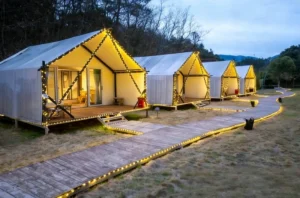
Today, the Desert Dome has become an iconic structure for desert campsites, eco-resorts, and stargazing hotels. With its striking design and immersive spatial experience, it has become a “naturally attractive” landmark for tourists to take photos. If you’re planning an attractive desert camping project, the Desert Dome is undoubtedly an ideal choice that balances uniqueness, cost-effectiveness, and commercial value.
What is a Desert Dome?
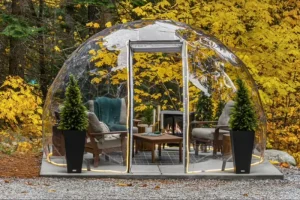
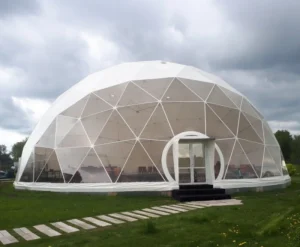
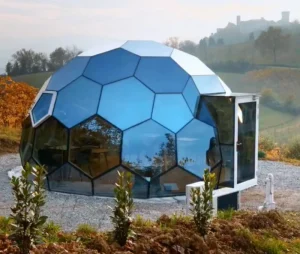
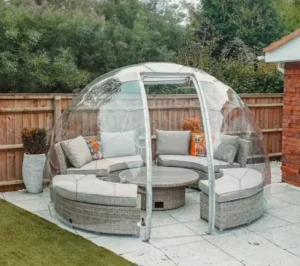
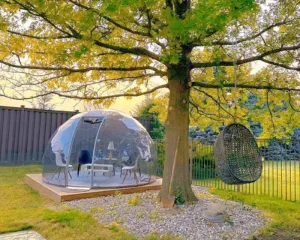
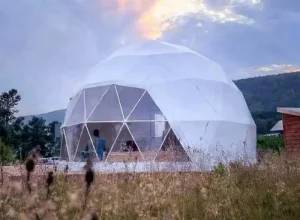
A Desert Dome is a spherical or hemispherical architectural structure specifically designed for desert or extreme climate environments. It typically uses a steel or aluminum alloy frame as its skeleton, covered with a high-strength PVC membrane or transparent PC board, combining strength, insulation, and visual appeal.
This structure, with its unique shape and excellent environmental adaptability, is widely used in desert camps, eco-resorts, stargazing hotels, art galleries, and temporary event spaces.
Why Choose a Desert Dome? Five Core Advantages Explained
If you’re still hesitant about investing in such a high-tech building, consider its irreplaceable advantages over traditional buildings.
1. Up to 60% Energy Consumption Reduction
Traditional brick-and-mortar houses require continuous cooling to maintain a comfortable temperature in desert environments, resulting in staggering air conditioning power consumption. According to the International Energy Agency (IEA), building cooling accounts for more than 50% of total annual electricity consumption in the Middle East. The Desert Dome, with its streamlined design and highly efficient insulation materials, effectively reduces heat convection and radiation. 1. **With passive cooling systems (such as underground ventilation shafts and evaporative cooling walls), the indoor temperature can be 8–12°C lower than the outside temperature, significantly reducing the cooling load.**
2.Excellent Wind and Sand Resistance
The most common challenge in the desert is sandstorms. Ordinary glass greenhouses are easily damaged in strong winds, and sand particles can damage equipment and clog pipes. Desert domes are different. Their structure often uses a combination of triangular grid steel frames and ETFE membrane material, with a wind resistance rating of up to level 12 (wind speed above 32.7 m/s). ETFE membrane has extremely strong weather resistance, a service life of up to 25 years, and a strong self-cleaning ability; rainwater can wash away dust.
In contrast, traditional steel structure greenhouses require replacement of the membrane or repair of the frame every 3–5 years, resulting in high maintenance costs. A well-designed desert dome can operate stably for more than ten years in extreme environments without major repairs.
3. 40% Increased Space Utilization, Suitable for Multiple Uses
Traditional flat-roofed buildings are limited by load-bearing constraints, making it difficult to create large-span spaces. The dome structure naturally possesses mechanical stability, with individual spans exceeding 30 meters and a column-free internal design, greatly enhancing its usability.
Whether used as a vertical farm, desert hotel suite, or research laboratory, it can be freely arranged. Data shows that, for the same land area, the effective usable area of a dome is approximately 37% higher than that of a rectangular building.
More importantly, multiple domes can be combined through connecting passageways to form a cluster-style ecological community.
4. Water Resource Recycling, Water Saving Efficiency Up to 90%
Water scarcity is the biggest bottleneck for desert development. Traditional irrigated agriculture requires approximately 300 liters of water to produce 1 kilogram of vegetables, and the evaporation rate is extremely high in open environments. Desert domes, through a closed-loop water recycling system, condense and recover the water transpired by plants. Combined with aeroponics or mist cultivation technology, water consumption can be reduced to only 20-30 liters per kilogram of output.
Experiments by the Israeli agricultural research institution Negev Arid Zone Laboratory have demonstrated that growing lettuce in domes equipped with intelligent irrigation controllers reduces water consumption per unit yield by 88% compared to open fields, and shortens the growth cycle by 15 days. For countries with extremely scarce water resources, this is a technologically significant breakthrough with strategic importance.
5. Rapid Deployment, Adapting to the Construction Needs of Remote Areas
Traditional construction often takes months from foundation laying to topping out, especially in remote desert areas where construction is more difficult. Desert domes mostly use prefabricated components, and on-site assembly can be completed within 72 hours.
The dome requires approximately 30% less structural material than traditional buildings because its geometry itself is highly efficient and strong. This means less material waste, lower transportation costs, and a smaller carbon footprint. This construction model naturally aligns with your pursuit of sustainability and green building.

Are Desert Domes Expensive?
Are you planning a high-end eco-resort or building a modern, year-round desert greenhouse farm? The first question that might come to mind is: “Will the cost of such high-tech buildings be prohibitively high?” Indeed, compared to traditional single-layer film greenhouses, desert domes require a higher initial investment. However, if you consider the cost over a 10- or even 20-year operating cycle, its economic advantages become very clear.
The price of desert dome tents depends primarily on their size and intended use.
Dome tents with a diameter of 5–6 meters offer approximately 20–30 square meters of interior space and are typically designed as luxury campsite accommodations for 2–4 people. These tents are fully equipped, easy to set up, and suitable for couples or small families, with market prices generally between USD 1,000–3,000.
Dome tents with a diameter of 7–8 meters offer approximately 40–60 square meters of space, accommodating more furniture and amenities, and are commonly used for family vacations or boutique campsite projects. These tents are spacious, accommodating a separate bathroom, kitchen, and viewing area, with prices ranging from approximately USD 3,000–8,000.
Large dome structures with a diameter of 9 meters or more typically offer more than 60–100 square meters of space and are often used for commercial events, exhibition spaces, or desert catering campsites. These types of tents typically require custom design, have more complex structures, and use higher-end materials, with an overall cost of approximately USD 8,000–20,000 or more.
While the initial investment may be higher than a simple desert prefabricated house, you must consider the long-term energy savings of a desert dome. Due to its superior insulation and thermal management capabilities, the reduced operating costs can offset the higher initial construction costs within 5 to 10 years, resulting in a substantial long-term return on investment.
5 Key Considerations When Choosing a Desert Dome
Faced with a dazzling array of products on the market, how do you make an informed choice? Here are five essential factors you need to consider when selecting a desert dome.
1. Material Quality Determines Lifespan
Not all “ETFE membranes” are created equal. Inferior membranes are prone to aging and yellowing, with light transmittance decreasing by more than 30% within three years. High-quality imported ETFE membranes (such as those from Covestro, Germany) maintain a light transmittance of over 95% and meet the ISO 4892 standard for UV protection. It is recommended to prioritize brand suppliers that clearly indicate the source of their raw materials.
2. Structural Design Must Meet Local Climate Conditions
Wind pressure, dust concentration, and diurnal temperature variations differ significantly across desert regions. The average wind speed in the North African Sahara is high, necessitating a reinforced anchoring system; while the cold winters in the Central Asian Gobi Desert require increased insulation thickness. Professional manufacturers will provide customized structural calculation reports based on GIS meteorological data, ensuring a safety redundancy of ≥1.8 times.
3. Is the Control System Intelligent?
A truly intelligent dome should possess IoT remote monitoring capabilities. You can use a mobile app to view real-time temperature, humidity, CO₂ concentration, and light intensity, and set automatic start/stop for ventilation, shading, irrigation, etc. Some high-end models also support AI learning modes, optimizing environmental parameters based on historical data to further improve crop yields.
4. Is the After-Sales Service Network Comprehensive?
Due to remote locations, rapid repair response is crucial in case of malfunctions. It is recommended to choose brands with global service centers, or at least those offering English technical support hotlines and video guidance services.
5. Scalability and Compatibility
You may want to add new functional modules in the future, such as aquaponics ponds, energy storage battery packs, or visitor reception areas. Therefore, choosing a design that supports interface reservations and power capacity expansion is particularly important.

Is Installing a Desert Dome Difficult?
Installing a desert dome is not particularly difficult, but it does require certain professional experience and equipment support. The difficulty depends mainly on the structural dimensions, terrain conditions, and the complexity of the supporting configurations.
For small desert domes with a diameter of 5–6 meters, a modular design is typically used, with prefabrication and labeling completed before leaving the factory. Two to three workers can complete the assembly within 1–2 days, requiring only a flat foundation.
When the dome size increases to 7–9 meters or more, the number of structural components increases, and the frame becomes heavier. At this point, it is recommended that a professional installation team be responsible for the construction. They will use power tools and hoisting equipment to ensure the steel structure joints are stable and the PVC or PC panels are evenly tensioned, avoiding deformation or leakage problems caused by uneven stress.
Furthermore, the environmental conditions of desert regions (such as strong winds, sandstorms, and large temperature differences) also need to be considered. To ensure safety and durability, most manufacturers provide ground anchoring systems, reinforcement supports, and installation guidance videos or on-site technical support to help customers quickly build their structures.
Overall, desert dome construction utilizes a modular + bolted connection structure, resulting in a short construction cycle and eliminating the need for welded foundations. As long as the installation instructions are followed, stable and safe construction can be completed in a short time.
Conclusion
Desert domes are powerful proof of addressing global climate challenges and expanding the boundaries of human habitation. By combining ancient geometric wisdom with modern high-tech materials, they provide a sustainable, safe, and efficient solution for living and research in one of the most extreme environments on Earth.
If you are looking for an ideal architectural solution that can withstand the desert heat while also possessing aesthetic and engineering quality, Gaxdome is your best choice.
We specialize in the design and manufacture of customized high-performance desert dome systems, using advanced UV-resistant, heat-insulating, and wind-resistant materials to maintain comfort and stability in harsh environments, creating a true “desert oasis” for you.
Whether you’re planning to build a campground, a resort hotel, or a commercial exhibition space, Gaxdome’s professional team can provide customized design solutions and comprehensive technical support tailored to your project needs.
Contact us today for more detailed information and a quote, and let Gaxdome help you unlock new possibilities in desert architecture.