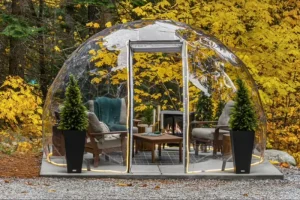
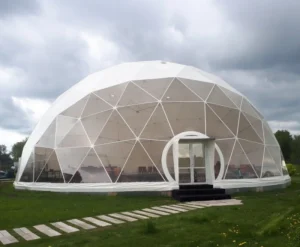
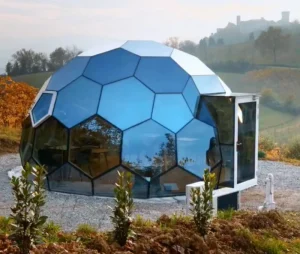
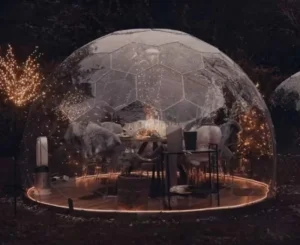
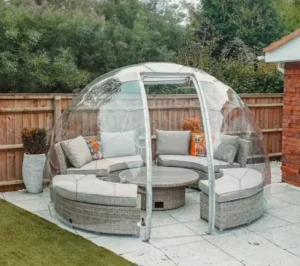
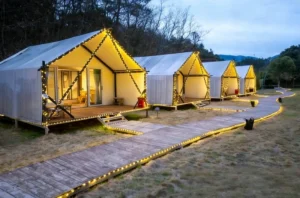
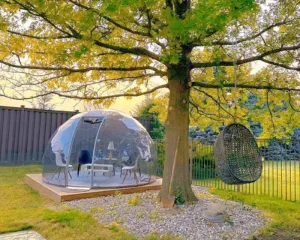
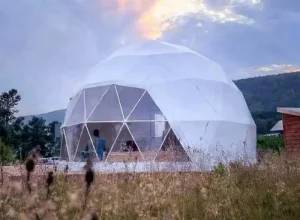
In the face of climate change and resource shortages, people are beginning to rethink the nature of living. Geodesic House, a spherical building made of triangular grids, is creating a living revolution around the world. It not only perfectly integrates modern aesthetics and ecological concepts, but also subverts traditional architectural cognition with its amazing structural performance.
An architectural revolution from a genius concept
The concept of geodesic house was first systematically proposed by American inventor Buckminster Fuller in the mid-20th century. This cross-border genius tried to solve the post-war housing crisis through geometry, inspired by the most stable structure in nature – the geometric arrangement of carbon molecules and virus shells. Fuller discovered that after decomposing a sphere into an equilateral triangle grid, the strength of the structure will increase as the size increases, which is a physical law against traditional architecture.
Modern geodesic houses have developed a variety of forms:
Lightweight camping domes (3-6 meters in diameter)
Standard family homes (10-15 meters in diameter)
Large public buildings (over 30 meters in diameter)
Excellent performance beyond tradition
In actual measurements during the Florida hurricane season, the damage rate of traditional houses reached 37%, while geodesic houses maintained a zero damage record. The secret is:
Aerodynamic design: spherical surface reduces wind speed by 40%
Stress distribution: triangular grid evenly distributes load
Material innovation: aviation-grade aluminum alloy frame + composite skin
Thermal performance test shows that geodesic houses of the same area in Beijing are compared with traditional buildings:
Winter heating energy consumption is reduced by 58%
Summer cooling demand is reduced by 43%
Natural lighting time is extended by 2.7 hours/day

Industrial revolution of modular construction
After a residential project in Shanghai adopted the prefabricated geodesic solution:
Construction period was shortened from 180 days to 45 days
Construction waste was reduced by 82%
Overall cost was reduced by 35%
Modular components can be assembled in a “Lego-style” manner, and a single worker can complete the construction of a 30㎡ basic frame in 8 hours. This construction method is particularly suitable for:
Ecological protection areas
Polar research stations
Geodesic House Redefining the aesthetics of life
A survey of residents in Shenzhen’s “Dome Community” showed that:
92% of residents believe that the sense of space is better than traditional houses
88% said that their mental health index has improved
79% have developed energy-saving living habits
Designer Wang Shu commented: “The geodesic structure breaks the inertia of living in a square box and makes people rethink their relationship with nature.”
The future has come
With the development of 3D printing technology, Malaysia has seen concrete geodesic houses that were printed within 48 hours. The use of smart materials allows the dome to change color temperature according to the weather, and the photovoltaic skin can achieve energy self-sufficiency.
As architectural critic Zhang Yonghe said: “This is not a change in architectural form, but a shift in civilization paradigm.” Geodesic houses represent not only an architectural choice, but also a solemn commitment of mankind to a sustainable future.