Introduction
Imagine waking up to the sound of birdsong in the morning and the sunlight pouring through your tent window. Imagine waking up in the morning to the sound of birdsong and the sunlight pouring through your tent window, surrounded by your loved ones or family, with a serene lake or rolling hills in the distance. This type of deep immersion in nature is at the heart of today’s outdoor camping programs.
Traditional tents often struggle to provide long-term comfort and convenience, while bulky fixed structures lose the flexibility of camping. It is against this backdrop that semi-permanent tents have emerged as the ideal choice for campground investors. They combine the mobility of a tent with the comfort of a building, providing visitors with a unique outdoor accommodation experience.
What Is a Semi-Permanent Tent?
Semi-permanent tents are accommodation structures that fall somewhere between a traditional lightweight tent and a permanent fixed building. They are typically constructed with prefabricated components that incorporate metal frames, durable membranes, canvas or timber structures. These tents can be set up and taken down quickly.
Unlike regular camping tents, semi-permanent canopies have a stronger structure, as well as superior resistance to wind, snow, and water. They can be integrated with modern amenities such as electricity, heating, and bathrooms to provide near-hotel-like comfort. These canopies can either be fixed in a location for a long period of time or relocated when needed.
Why Are Semi-Permanent Tents Preferred for Camping Projects?
There are a couple of core advantages that cannot be ignored that make semi-permanent tents preferred by camp projects. First, they have a relatively short payback period. Compared to building a traditional hotel or chalet, canopies typically have a lower initial investment, are quicker to erect, and can be up and running to generate revenue sooner.
Second, they offer a high degree of flexibility and scalability. Campsites can quickly add or remove accommodation units, or even adjust their layout, in response to changing market demand.
More importantly, semi-permanent tents provide a unique immersive experience. They can maximize the distance between people and nature, allowing visitors to enjoy the comfort of the outdoor life at the same time. This differentiation advantage makes the camp stand out from the homogenized competition. In addition, many tent designs focus on environmental friendliness and have a low impact on the environment, in line with the concept of sustainable development.
Types of Semi-Permanent Tents Suitable for Camps
Among the many types of semi-permanent tents, there are several types that are particularly suitable for camp programs due to their unique features and aesthetics.
Geodesic Dome Tent
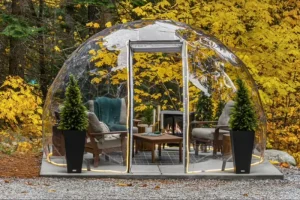
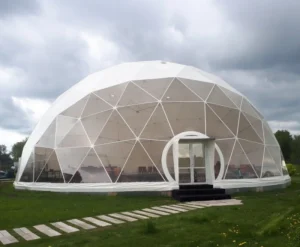
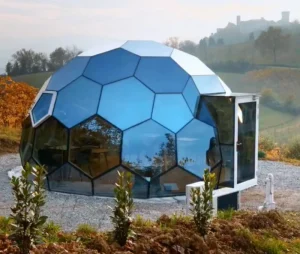
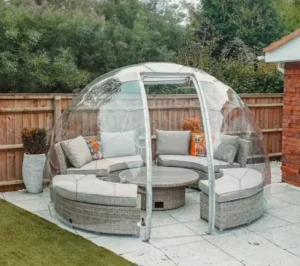
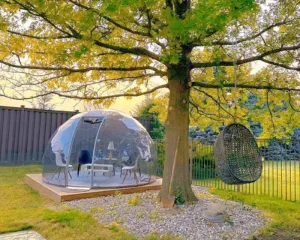
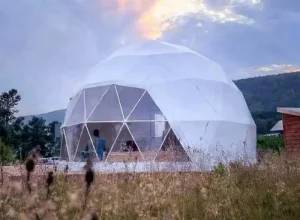
The geodesic dome tent is highly iconic in camps with its unique hemispherical appearance, strong wind resistance and panoramic views.
The frame is made of steel tubes or aluminum alloys for a lightweight yet extremely stable structure.
The cover is made of double-layer PVC or PVDF membrane and can be fitted with a transparent window, skylight or sunshade.
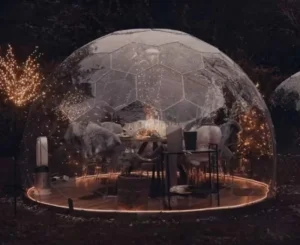
Scenarios: mountain, desert, grassland, forest can be set up, especially suitable for creating a “star house” or “forest round house”.
Safari Canvas Tent with Wooden Frame
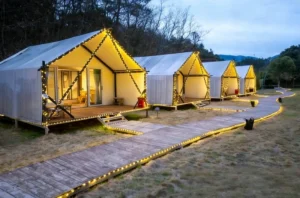
The Safari tent is characterized by its natural style and solid wood construction, and the warmth of the canvas creates a rustic yet elegant atmosphere.
The front gable extension can be used as an open-air refreshment area or as a viewing platform.
The interior space is well organized, making it easy to divide the bedroom, living room and bathroom areas.
Applicable scenes: woodland, waterfront, safari parks, nature reserves, etc.
Hard Top Box Tent
This type of tent is more similar to the light modular house, equipped with rigid wall and roof structure, the overall stability is strong.
Some models can be pre-installed with glass doors, windows, bathroom systems and kitchen modules, which are very suitable for medium and high-end long-stay camps or cold climate areas.
Scenarios: Highlands, forests, winter camps, high-end campgrounds, etc.
Double Roof Tent
Duble roof tent is designed with a double-layer structure, with an air buffer layer on the roof part, which greatly improves the overall heat insulation performance.
At the same time, solar modules can be installed on the roof to provide independent energy solutions for the campsite, which is more adaptable.
Applicable Scenarios: Tropical areas, desert areas, campsite projects that require long time exposure to the sun or extreme temperature difference.
Semi-Permanent Canopies vs. Permanent Tent Homes
When planning campground accommodations, operators often hesitate between semi-permanent canopies and permanent tent homes. Overall, semi-permanent tents are more flexible and have a shorter payback period, while permanent tented homes are suitable for stable, long-term operations.
Here are the core differences between the two:
Setup Cycle
Semi-permanent tents are typically set up in just 1-3 days, making them ideal for seasonal or quick-start camping projects.
Semi-permanent tents are typically set up in 1-3 days, making them ideal for seasonal or quick-start camping projects, while permanent tented homes require weeks or even months of construction time.
Relocatability
Semi-permanent tents are lightweight, easy to dismantle, and can be redeployed to suit your project.
Permanent tented dwellings, once constructed, cannot be moved and are less flexible.
Investment Costs
The investment for a single semi-permanent tent is roughly $1,500-$10,000.
Permanent structures often cost more than $10,000, or several times that.
Building Permits
Most jurisdictions do not require building permits for semi-permanent tents, making them ideal for quick start-up projects.
Permanent structures often require building permits, which can be lengthy and complicated.
Operational Flexibility
camps can deploy semi-permanent tents during peak seasons to meet varying capacity needs.
Permanent structures, on the other hand, are difficult to change, making it difficult to respond quickly to market changes.
Gaxdome Semi-Permanent Tent Types Recommended
As a brand specializing in high-quality semi-permanent tents, Gaxdome offers a wide range of solutions that can meet the needs of different campsites.
For campsites seeking the ultimate in visibility and modernity, we highly recommend Gaxdome’s dome tent series. They are made of high-strength galvanized steel tubes or aluminum alloy frames with imported environmentally friendly PVC/PVDF membranes, which not only have strong structure and excellent aging resistance, but also can withstand all kinds of harsh weather.
We offer a wide range of size options, from small private stargazing domes to large event domes, which can be customized according to the campsite size and functional needs. We also support high-end amenities such as internal integrated bathrooms, kitchens, and air conditioning.
If your campground favors a more classic, back-to-nature style, then Gaxdome’s line of Safari tents is ideal for you. Our Safari tents are constructed with high-quality preserved timber for the frame, paired with high-density, waterproof, mildew-resistant and flame-retardant special canvas to ensure the durability and comfort of the tents. Their spacious interiors and separate terraces provide guests with a private and comfortable outdoor retreat.
We offer standard configurations and welcome customization options, including sizes, interior layouts, and even specific wood or canvas colors to perfectly fit the theme and atmosphere of your campsite.
Whether it’s a modern, luxurious dome or a classic, natural safari, Gaxdome offers high-quality, cost-effective semi-permanent tent solutions. We support the entire process from design to installation.
Planning and Advice for Setting Up a Campsite
Successful campsite projects cannot be achieved without careful planning.
First of all, site selection is key. Consider the convenience of the location, the attractiveness of the natural environment (e.g. landscape), and the accessibility of the infrastructure (water, electricity, transportation). At the same time, be sure to study local land use regulations and building approval requirements.
Next, define the theme of the campground and the target clientele. Do you want to attract family travelers or backpackers? Do you want to focus on eco-luxury or parent-child study? A clear positioning will guide your decision on tent selection, internal facilities configuration, and marketing promotion.
Then, carry out detailed functional zoning. In addition to the accommodation area, you also need to plan the reception center, public bath, dining area, leisure activities area, parking lot and so on. A reasonable layout can enhance visitor experience and campground operational efficiency. When it comes to the internal facilities of the tent, focus on comfort and convenience. Quality mattresses, stable power supply, adequate lighting, reliable heating/cooling equipment, and tidy bathroom facilities are core elements to enhance the stay experience.
Finally, don’t forget about sustainable operations. Choose eco-friendly materials, implement waste separation, and manage wastewater treatment. All of these will earn your campground a good reputation in the community and reduce long-term operating costs.
Summary
The rise of semi-permanent canopies has revolutionized camping programs. With their unique appeal – flexibility of investment, ease of erection, and superior outdoor experience – they are reshaping the face of modern camping. Whether it’s the futuristic dome tent or the classic, timeless Safari tent, they are providing campground operators with more diverse and attractive lodging options.
With thoughtful planning and high-quality tenting options, your campground will be able to create memorable outdoor lodging experiences for your visitors. This can also help you gain a foothold in the booming tourism market. It’s time to consider incorporating these innovative canopies, into your campground blueprint.