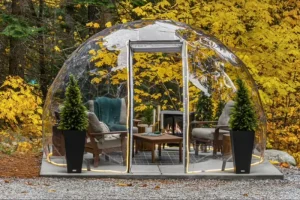
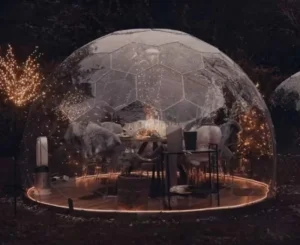
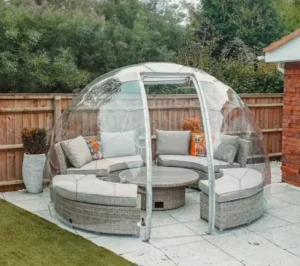
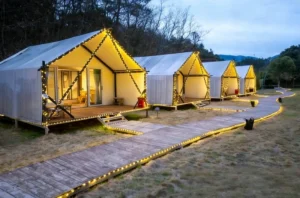
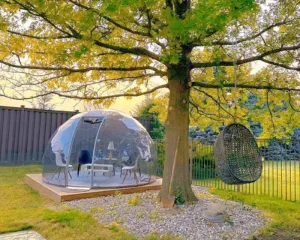
Have you heard of the Plexiglass Igloo? It’s a transparent dome structure that has become wildly popular worldwide in recent years, seamlessly integrating into various outdoor settings, from snow camping in Scandinavia and open-air restaurants in New York City to stargazing spaces in private backyards.
Unlike traditional tents, the Plexiglass Igloo is more like a small panoramic glass house. It provides wind and cold protection, rain and snow protection, while allowing sunlight to stream in naturally, creating a comfortable space that connects people with nature and is unaffected by the weather.
Next, we’ll give you a comprehensive overview of the Plexiglass Igloo’s construction features, cost, heat dissipation performance, and material lifespan, helping you make a more informed choice before purchasing or setting it up.
What is the Plexiglass Igloo? How is it different from other outdoor domes?
The Plexiglass Igloo is a spherical structure assembled from transparent PMMA (polymethyl methacrylate) panels and an aluminum alloy frame. It has a crystal-clear appearance and a light transmittance of up to 92%. Inspired by the Arctic igloo, this design combines modern aesthetics with practicality, making it suitable for various settings such as backyard relaxation spaces, dining booths with scenic views, high-end glamping sites, and stargazing cabins or greenhouses.
In the outdoor architecture field, “Plexiglass” is a general term referring to various transparent plastic sheets. High-quality Plexiglass igloos often use materials like **polycarbonate (PC) or polyvinyl chloride (PVC),** which are lighter, more impact-resistant, and offer excellent weather resistance than traditional glass.
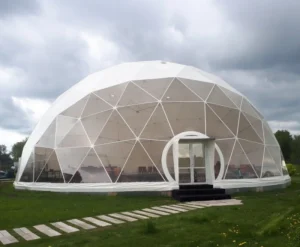
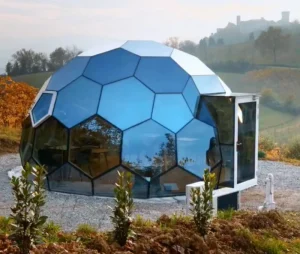
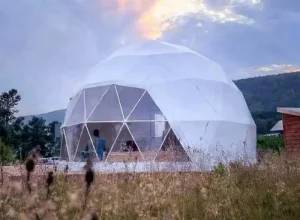
These transparent igloos typically employ a geodesic dome structure, ensuring overall strength and stability while creating a unique geometric aesthetic. Compared to ordinary tents, they are more robust; compared to glass greenhouses, they are safer; and they are easy to install, achieving a perfect blend of comfort, privacy, and natural scenery.
In simple terms, the Plexiglass Igloo is like a “mini panoramic greenhouse,” allowing people to comfortably connect with nature and enjoy the starry sky and beautiful scenery throughout the changing seasons.
What materials is the plexiglass igloo made of?
Currently, Plexiglass Igloo structures on the market are primarily made from three types of materials:
PVC membrane structure, PC polycarbonate sheets, and Plexiglass (acrylic sheets).
Each material offers unique advantages in transparency, durability, weather resistance, and cost.
Choosing the right material is crucial to determining the igloo’s comfort, longevity, and overall value.
Material Comparison Table
Material Type | Transparency | Impact Resistance | Weather Resistance | UV / Yellowing Resistance | Durability | Lifespan | Cost Range (USD/㎡) | Features and Applications |
PVC Membrane Structure | ★★★ (Medium) | ★★ (Low) | Average | Poor — prone to aging under long-term sunlight | Low (easily punctured, deformed) | 2–3 years | $20–40 | Lightweight and foldable; ideal for short-term or seasonal use; economical option |
PC Polycarbonate Sheet | ★★★★ (High, ~89% light transmittance) | ★★★★★ (Extremely strong) | Excellent | Very good — with double-sided UV protection | Extremely high (used in bulletproof glass) | 8–10 years or more | $50–80 | High impact and UV resistance; perfect for year-round use and commercial settings |
Plexiglass (Acrylic PMMA) | ★★★★★ (Extremely high, ~92% light transmittance) | ★★★★ (Medium-high) | Good | Average — offers some UV protection | Medium-high (stronger than glass) | 5–8 years | $60–100 |
Many people mistakenly believe that “Plexiglass Igloos” are always made of acrylic sheets, but in fact, truly high-end and durable Plexiglass Igloos are usually made of polycarbonate (PC) sheets.
This material not only has the high transparency of acrylic but also has higher impact resistance and weather resistance, maintaining a stable structure in environments such as wind, snow, ultraviolet radiation, and high temperatures.

How much does a Plexiglass Igloo cost?
The price of a Plexiglass Igloo can vary widely depending on several key factors — including diameter (size), panel thickness, frame material, and accessory configuration (such as doors, ventilation systems, or lighting).
Below are reference prices in the international market to give you a general idea:
Size (Diameter) | Capacity | Price Range (USD) | Typical Use |
3 meters | 2–3 people | $1,200 – $1,800 | Family patios, backyard relaxation, sun bubble houses |
4–5 meters | 4–8 people | $2,000 – $3,800 | Outdoor dining areas, scenic viewing domes, cafés |
6–8 meters | 8–15 people | $4,500 – $8,000+ | Commercial glamping sites, event venues, exhibition spaces |
Plexiglass Igloo Cost Components
For a 6-meter diameter Plexiglass Igloo (accommodating approximately 10 people), the total cost is typically between $6,000 and $7,000, depending on the customized configuration. The cost can be broadly divided into several main components:
Sheet material cost accounts for approximately 35% of the total cost, as the thickness of the acrylic sheet directly affects the price. Generally, 3mm thick sheets are suitable for family patios or small viewing spaces, while 5mm thick sheets are more suitable for commercial use or scenarios requiring greater wind and snow resistance.
The frame structure accounts for approximately 25% of the cost. Aluminum alloy frames are lightweight and easy to install, while galvanized steel frames are more durable and resistant to wind and snow, but are also more expensive.
Doors, windows, and ventilation design account for approximately 10% of the total cost, including window openings, vents, and door locks, ensuring comfort and air circulation inside the igloo.
The foundation and waterproofing system account for approximately 15%, mainly for floor reinforcement, waterproofing pads, or bases, ensuring the stability and durability of the igloo, especially important in rainy or snowy weather.
Transportation and installation costs also account for approximately 15%. Choosing a modular design and self-installation can significantly reduce labor costs, while long-distance transportation costs will vary depending on the region.
This cost distribution clearly shows the proportion of each component in the total cost and how to optimize the budget by selecting materials, frames, and accessories according to actual needs.
Budget-Saving Tips for Plexiglass Igloo
When purchasing a Plexiglass Igloo, there are several ways to effectively control your budget without compromising the user experience:
First, choosing a modular design and DIY assembly is the most direct way to save money. Many igloos use a bolt-on assembly structure, which can be completed by 2-3 people, eliminating the need for a professional team. For an igloo with a 6-meter diameter, this method can save approximately $500–$1,000 in labor costs.
Second, avoiding overly customized transparent curved surfaces or decorations is also key to cost reduction. Overly complex curved surface processing and additional decorations not only increase material waste but also significantly increase processing difficulty. Typically, simplifying the design can reduce total costs by 10–15%.
If the igloo is only used for seasonal activities, choose a semi-fixed base instead of a permanent foundation. This facilitates disassembly and saves approximately $300–$500 in foundation construction costs.
Furthermore, opting for local OEM production can significantly reduce shipping costs. Compared to shipping complete modules from overseas, local production can save approximately $500–$1,000, making it particularly suitable for projects or commercial sites requiring multiple igloos.
Overall, by choosing appropriate design, installation methods, and production channels, the overall budget can typically be reduced by 15–25%, while still ensuring the igloo’s aesthetics and durability, allowing you to enjoy the unique experience of a transparent igloo at a higher cost-performance ratio.
Won’t a plexiglass igloo be too hot?
This is the biggest concern for all potential buyers. After all, if a transparent dome is unusable in the summer, its value as an “all-season” outdoor solution is greatly diminished.
How to ensure heat dissipation for the Plexiglass Igloo in summer?
The advantage of transparent materials is that they can maximize the use of solar energy and natural light. However, once closed, it creates a significant **”greenhouse effect”**, with the internal temperature potentially 10-20°C higher than the external temperature under direct sunlight.
Therefore, heat dissipation performance is a key factor in evaluating the quality of an igloo design. When choosing an igloo, you must pay attention to these three key features:
- Top Vents: Hot air rises, and top vents are the main channels for expelling accumulated heat. A good design should have multiple, adjustable vents, not just a single window.
- Cross Ventilation: Ensure the igloo has at least two, ideally multi-angled, vents or windows to create air convection and effectively remove internal heat.
- Shade Cover: This is the most effective cooling tool. It’s not transparent, but a high-density shade net or canvas that blocks 70% to 90% of solar radiation. During the hottest hours of summer (midday to 3 pm), a shade cover must be installed to prevent excessive internal temperatures.
How to Transform a Transparent Igloo into a Warm and Comfortable Shelter in Winter?
In the cold season, the greenhouse effect of a transparent igloo becomes an advantage.
- Solar Heating: Even when the outside temperature is near freezing, sunlight can quickly raise the internal temperature, allowing you to enjoy warmth in the sun.
- Warmth Management: Use a small, efficient infrared heater or electric heater. Due to the relatively enclosed space, heat loss is slow; typically, a 1500W heater is sufficient to maintain a comfortable internal temperature above 20°C in environments around freezing.
- Insulation: Some high-end models offer additional winter insulation linings to further reduce heat loss and improve nighttime warmth.

How long will a plexiglass igloo last? Is it prone to cracking?
Having invested thousands of dollars in an outdoor dome, you naturally expect it to last a long time, not just deteriorate after two years. Durability largely depends on the materials you choose and the manufacturer’s craftsmanship.
If you choose a polycarbonate (PC) hard-shell igloo, you don’t need to worry about cracking.
Impact Resistance: PC material has over 200 times the impact resistance of ordinary glass; it can withstand impacts from hail, flying stones, and even heavy objects without breaking.
Lifespan Guarantee: PC panels from top international brands typically undergo special processing, featuring a high-standard UV protective coating. This coating is crucial to preventing yellowing and brittleness. With proper care, their lifespan can typically reach 8 to 10 years, or even longer.
Wind and Snow Resistance: The geodesic structure of high-quality igloos provides excellent wind resistance. For example, many commercial-grade igloos can withstand winds of force 7 or even 8 (wind speeds of approximately 50-75 km/h). For snow accumulation, clearing is generally required when the snow depth reaches 15 cm to ensure safety.
Tolerance: Withstands temperatures from -30°C to +70°C, adaptable to various climatic conditions.
FAQs about Plexiglass Igloo
1: How long does it take to set up and dismantle a Plexiglass Igloo?
A: It depends on the size and materials. A standard 4-meter PVC igloo can typically be set up by two people within 2-3 hours. A precast concrete (PC) hard-shell igloo may take 4-6 hours to build due to its more components and stronger frame, but once assembled, it can be used year-round without dismantling.
Q2: Do I need a municipal permit to build a transparent igloo in my backyard?
A: It is strongly recommended that you consult your local municipal building or planning department. Most areas consider this type of non-permanent, movable outdoor structure as a “temporary facility” or “tent” and may not require complicated building permits. However, if the igloo’s diameter exceeds a certain size (e.g., 4 or 5 meters) or has a permanent foundation, approval may be required.
Q3: Can a transparent igloo be installed on any ground?
A: Ideally, an igloo should be installed on a flat, hard surface, such as a wooden deck, concrete, or paved stone. While it can be installed on grass, the ground must be level, and it must be secured using strong anchoring devices such as pegs or sandbags.
Q4: How should the igloo’s entrance/door be designed?
A: There are three common types: zippered soft membrane doors (PVC membrane), hard-shell sliding doors (PC or aluminum alloy), and roller shutter doors. Hard-shell doors offer better sealing and security, but are more expensive.
Conclusion
Whether it’s a starry night in your backyard or an open-air restaurant in the city center, the Plexiglass Igloo allows you to experience the pure beauty of nature throughout the four seasons. Choosing the right size, controlling your budget, and paying attention to heat dissipation and material maintenance are key to achieving the perfect user experience.
If you are looking for a high-quality transparent igloo, Gaxdome offers a one-stop solution from design and production to global shipping, using a high-strength aluminum alloy structure and optical-grade Plexiglass material, balancing aesthetics and durability.
Contact us today to inspire and unlock your transparent space.