Introduction
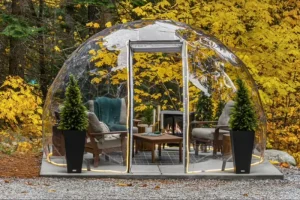
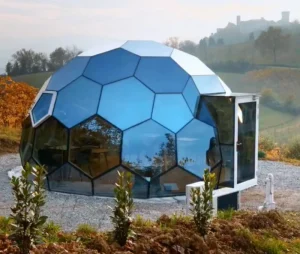
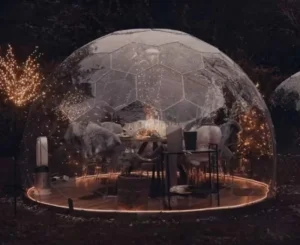
If you are planning a campsite, resort, or outdoor commercial space, you may have noticed that dome structures are becoming increasingly popular.
However, while dome structures may look similar, there are many subtle differences. Among them, Hybrid Domes and Geodesic Domes are the most commonly discussed types. Although they may look similar in appearance, their structure, function, and user experience differ significantly.
The following will provide a detailed introduction to Hybrid Domes and Geodesic Domes, focusing on their structure and applicable scenarios. Hopefully, after reading this, you will be able to choose the most suitable option for your needs.
What is a Hybrid Dome?
A hybrid dome is also known as a mixed dome.Compared to a geodesic dome, you can think of a Hybrid Dome as a dome structure “optimized for practical use.”
It typically utilizes the advantages of at least two different building systems or materials, overcoming the limitations of a single structure in terms of practicality, construction, or durability. This means that Hybrid Domes are not only aesthetically pleasing and sturdy but also more suitable for long-term use, such as campsite accommodation, commercial spaces, or outdoor activity projects.
What are the Differences Between a Hybrid Dome and a Geodesic Dome?
The differences between Hybrid Domes and Geodesic Domes are not only reflected in their appearance, but also in their structural design, space utilization efficiency, and construction experience.
Geodesic Domes emphasize overall load-bearing capacity and extreme stability, while Hybrid Domes, while ensuring safety, focus more on spatial practicality and project implementation efficiency.
Understanding this will help you determine which structure is more suitable for your needs in your actual project.
Differences in Structural Design
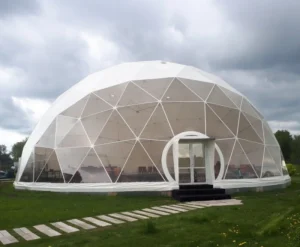
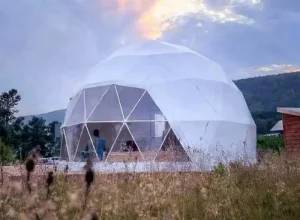
If you choose a Geodesic Dome, it uses a complete triangular grid structure, where every unit participates in the overall load-bearing.
This means it is very stable in windy and snowy conditions. A standard Geodesic Dome can withstand continuous wind speeds of approximately 100–120 km/h, with a snow load capacity of 75–120 kg/㎡, maintaining high stability even in extreme weather.
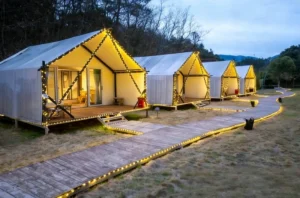
A Hybrid Dome, on the other hand, uses an arched main structure with localized reinforced frames for support, without requiring every component to bear the load.
For you, its wind resistance is generally 80–100 km/h, and the snow load is approximately 50–80 kg/㎡, which meets the needs of most campsites and commercial projects, while the structure is simpler and the materials and connections are easier to manage.
Differences in Spatial Form
When you enter a Geodesic Dome, you’ll find that the walls have a large curvature, and the space gradually narrows from the center to the edges.
Although the central area is spacious, the areas near the edges are less efficient, and placing beds, furniture, or creating partitions may require extra customization.
In contrast, the side walls of the Hybrid Dome are more upright, and the interior space is closer to the form of traditional buildings.
For you, this means that furniture can be placed naturally against the walls, storage areas and functional zones are easier to plan, making it more suitable for long-term accommodation and commercial operations.
Different Installation Methods and Construction Experience
The construction of a Geodesic Dome is more like an engineering project. It involves many components and dense nodes, requiring high levels of construction experience and precision. The complete construction cycle for a medium-sized dome usually takes 3–5 days or even longer.
The installation logic of the Hybrid Dome is more intuitive, with fewer components and clearer steps.
If you plan to quickly launch a project, most standard-sized Hybrid Domes can be installed within 1–3 days, reducing labor costs and making it easier to control the construction period.

What are the advantages of the Hybrid Dome?
You might be wondering why more and more projects are choosing the Hybrid Dome? The reason is that it is more user-friendly in practical use.
Whether it’s space utilization, cost control, or long-term operational experience, the advantages of the Hybrid Dome are reflected in the details. Below, let’s look at some of the most significant advantages.
Better usable space is the most intuitive advantage
Many users tell us that their first impression is that “it’s easier to arrange things inside.”
The side walls of the Hybrid Dome are more upright, allowing beds, sofas, and storage cabinets to be placed naturally against the walls without being restricted by significant curvature.
If your project is primarily for accommodation, the Hybrid Dome usually provides a higher proportion of usable area at the same diameter, and space planning is more flexible.
More favorable cost structure
The Hybrid Dome has a simplified structure, more concentrated material usage, and lower difficulty in node processing.
For you, this means that production, transportation, and installation are easier to control.
When you need to build multiple domes, the cost advantages brought by this structure are particularly evident.
More suitable for long-term use and operation
The Hybrid Dome is designed with ease of maintenance and replacement in mind.
If your campsite or commercial space requires long-term operation, it means less maintenance pressure and controllable operating costs in the long run.
Over time, you will find that overall stability and user experience are easier to maintain. The appearance blends more easily into the environment.
Compared to the strong visual impact of the Geodesic Dome, the Hybrid Dome has a more architectural design.
It doesn’t overly emphasize the structure itself, making it easier to coordinate and integrate with your overall plan or natural environment.
This is especially important if you want a low-key and comfortable atmosphere for your project.
Hybrid Dome vs. Geodesic Dome: How to choose the right structure for your project?
There is no single right structure choice for your project; the key is to determine which structure best suits your goals.
If you are focused on long-term accommodation or commercial operation, the Hybrid Dome is a safer choice, offering high space utilization, controllable costs, and convenient maintenance.
If you are pursuing visual impact or your project is located in extreme weather conditions with strong winds and heavy snow, the Geodesic Dome is more suitable.
In some mature projects, both structures are used simultaneously, fulfilling different functions to make the overall plan more rational.

Can the Hybrid Dome replace the Geodesic Dome?
In most conventional applications, you can completely replace the Geodesic Dome with a Hybrid Dome.
Especially in projects with mild climates that emphasize living experience and spatial practicality, the Hybrid Dome often provides a better user experience.
However, if the project requires high structural performance or is located in extreme climate regions, the Geodesic Dome remains a more reliable choice.
From a trend perspective, the Hybrid Dome is covering more and more scenarios originally dominated by the Geodesic Dome, which is more due to real-world project feedback than purely theoretical comparisons.
Conclusion
The difference between Hybrid Domes and Geodesic Domes lies not only in their structural form but, more importantly, in their suitability for different applications.
If you prioritize long-term use, comfort, and operational control, a Hybrid Dome is a better fit for your needs; if you seek extreme stability or a strong visual impact, a Geodesic Dome still holds unique value.
There is no single standard answer to which dome tent structure is more suitable; the choice depends primarily on your specific application, environment, and project goals. Considering practical usage scenarios is crucial for selecting a dome structure that is more durable and provides a better experience.
As a professional dome tent manufacturer, GaxDome has over 23 years of design and manufacturing experience, offering various customized solutions for both Hybrid Domes and Geodesic Domes.
Whether you need a dome tent for a campsite, event venue, or commercial display project, GaxDome provides a one-stop service from structural design and material selection to construction and installation.
FAQs about Hybrid Dome
1.What is the lifespan of a Hybrid Dome?
The Hybrid Dome is designed with durability and ease of maintenance in mind. Typically, it has a lifespan of 10–20 years, but the exact lifespan will depend on the materials chosen, climate conditions, and maintenance frequency. It’s a very reliable option for long-term camps and commercial projects.
2.Is the Hybrid Dome difficult to install? Does it require a professional team?
Compared to Geodesic Domes, the Hybrid Dome is more intuitive to install, with fewer components and clearer steps. Most standard sizes can be installed within 1–3 days, requiring relatively low technical skills from the construction team, making it fast and efficient.
3.Is the Hybrid Dome suitable for commercial projects?
The Hybrid Dome is ideal for commercial projects such as campsites, resorts, and event venues. It offers high space utilization, easy maintenance, and controllable costs, facilitating long-term operation and management, allowing you to easily plan and manage your project.
4.What are the costs of a Hybrid Dome?
The simplified structure means more efficient use of materials and reduced complexity in joint processing. For you, production, transportation, and installation costs are easier to control, making it particularly advantageous for campsites or commercial projects requiring multiple structures, resulting in a more cost-effective overall investment.