If you’re looking for the right outdoor structure for a campsite, courtyard, guesthouse, or a commercial space that you want people to “want to walk in at first glance,” you’ve probably already been drawn to hexagonal domes. Their shape is distinctive enough without being overwhelming. However, once you start choosing, you’ll immediately encounter a practical problem—which material to choose?
The most common hexagonal domes on the market are made of three materials: polycarbonate (PC), glass, and a combination of glass and wood. They all look beautiful, but the experience, budget, and usage scenarios are completely different.
If you’re also standing at this crossroads, unsure which way to go, this article will help you find your way in minutes.
Why are hexagonal domes so popular?
In recent years, whether you’re visiting a valley campsite, strolling through an urban courtyard, or at a popular tourist spot or in a shopping mall pop-up event, you’ll find that the presence of hexagonal domes is becoming increasingly prominent. It seems to have suddenly burst onto the scene, yet it doesn’t feel out of place at all; instead, it quickly becomes the “atmosphere maker” in many settings.
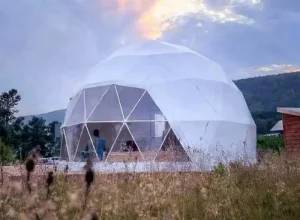
The reason for this structure’s popularity is actually quite simple. The hexagon itself possesses a natural geometric beauty, more modern than a traditional dome, and more dynamic than a square structure. When you enter such a space, you’ll immediately feel its spaciousness and cleanliness; every corner is utilized, and the visual flow is more open.
More importantly, it’s incredibly versatile. Whether you add furniture, greenery, or lighting to create ambiance, it easily presents different spatial effects. It can effortlessly handle the relaxed atmosphere of a campsite, the private relaxation of a terrace, the relaxed feel of a café, the artistic style of a guesthouse, and even visual displays in exhibitions and wedding settings.
However, what truly influences the user experience is often not the shape, but the material. Budget, lifespan, maintenance costs, ambiance, and even what you plan to use it for in the future are all closely related to the material. As you continue reading, you’ll discover that three common materials are like characters with distinct personalities; you need to choose the one that best suits your daily operations and lifestyle.

PC Hexagonal Dome
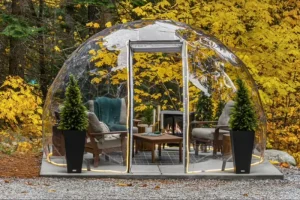
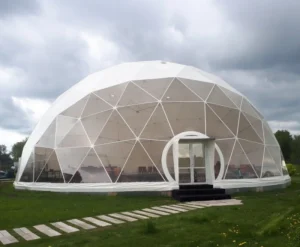
If you’re looking for a dome space that’s quick to install, durable, and budget-friendly, a PC hexagonal dome is often the first option that comes to mind. Its experience is instantly appealing—relaxed yet sophisticated.
So what exactly does it feel like?
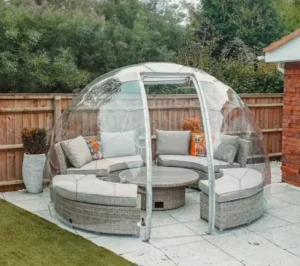
Imagine: a clean, geometric space covered by a light and warm material. Light streams in from the outside, not glaring, nor as directly transparent as glass; it retains a touch of softness, making the space both bright and private. If you prefer the gentle atmosphere of a botanical greenhouse, a PC dome offers a similar feel, only more refined and better suited for living and socializing.
And the reasons why many people choose PC as their first choice are quite practical.
- It’s lightweight, making transportation and construction effortless;
- It’s durable, impact-resistant, and resistant to damage from sun and rain;
- It allows for comfortable light transmission, maintaining a consistently gentle brightness in the space;
- Most importantly, it’s relatively affordable, making it ideal for users with limited budgets who want to quickly create their desired scene.
For those with short project cycles, frequent relocation, or who want to participate in the construction themselves, PC material can significantly simplify the entire process.
Where is it suitable?
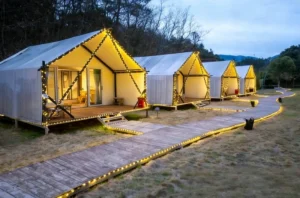
It can serve as an entry-level accommodation unit in a campsite, or create a small and beautiful resting corner in an urban courtyard;
It can appear in pop-up events and exhibitions as a bright display space;
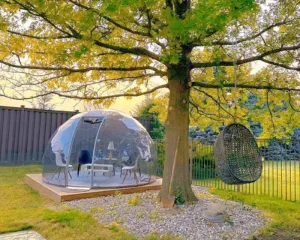
It can also stand quietly in a garden or on a terrace, becoming a personal corner you can use year-round.
If you’re preparing to test the waters in the dome market but don’t plan on investing too much upfront, starting with PC will be a safe, easy, and secure path.

Glass Hexagonal Dome
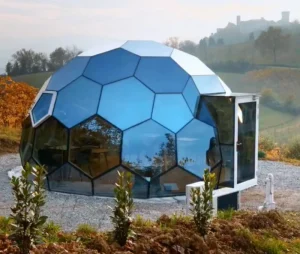
The first impression of a glass hexagonal dome is always closely associated with the word “high-end.” It’s not the transparency brought by a lightweight material, but a more realistic sense of stability and refinement. Standing in front of it, you feel like you’re not seeing a decorative scene, but a real cabin.
This feeling intensifies the moment you step inside. It’s as if you’ve stepped into a transparent viewing box, your view extending unobstructed. During the day, natural light streams in from all sides, making the space bright and pure; at night, the glass dome transforms into a “floor-to-ceiling window” stargazing device, the surrounding scenery quietly enveloping you, allowing you to be completely immersed in the environment. Its sharper lines and clearer contours make the entire structure appear clean, crisp, and possess a clearly defined “architectural feel.”
Many people ask: Why are glass domes more expensive?
The reason is quite straightforward—every single choice is “architectural”: More expensive materials, such as tempered glass and double-glazed windows; a more robust frame structure, often using steel or thermally broken aluminum; greater weight, requiring a stable foundation to achieve full performance; and a more professional installation process, demanding precise construction by a team.
But the investment yields a completely different experience: It’s more stable than a tent, more beautiful than a greenhouse, and more durable than lightweight structures.
You’ll clearly feel that you’ve acquired not a temporary space, but a true “small building” belonging to the outdoor environment.
It’s ideal for scenarios planned for long-term operation or requiring a high-value presentation: Stargazing rooms in scenic areas, valleys, or lakeside resorts; private viewing spaces in high-end courtyards; independent scenic rooms in restaurants and cafes; experiential spaces for high-end events by brands; long-term permanent art installations or exhibitions.
If you want this dome to accompany you for more than ten years and continuously generate value as a profitable space, then choosing the glass version is almost a sure bet. Its presence and stability are enough to make it a core asset in your project.

Mixed-Material Hexagonal Dome
A mixed-material hexagonal dome is a truly unique structure. It typically consists of glass panels paired with a wooden frame (or wood-grain aluminum), offering the transparency of modern architecture while retaining the warmth of natural materials. It looks clean, soft, and welcoming, instantly evoking a vacation scene.
Who is this style suitable for?
If you appreciate the natural feel of a log cabin while wanting to preserve the expansive views of glass, this mixed-material structure is usually the perfect match. It’s not as cold as all-glass, nor as lightweight and modern as precast concrete, but rather strikes the perfect balance between “nature + modern.”
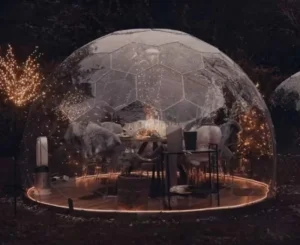
Stepping into such a dome, you’ll experience a very soft atmosphere. During the day, light naturally filters through the panels, bright but not glaring; at night, the lighting casts a warm golden hue on the wooden structure, making the entire space exceptionally comfortable. If you add some light-colored wooden furniture, warm-light lamps, and a few potted plants, you can quickly create a themed landscape space, perfect for taking photos and relaxing.
Because of its strong ability to create atmosphere, it’s especially attractive to project owners who value the experience. Whether you want to create a relaxing space where people can slow down, or a unique scene that visitors can’t help but take photos upon entering, it can easily handle it.
Where is it suitable?
- Boutique boutique guesthouses
- Themed campsites in forest, lakeside, or Nordic style
- Exclusive leisure corners in family courtyards
- Commercial exhibition spaces leaning towards art or lifestyle
If your goal is to make visitors exclaim “Wow!” the moment they open the door, then a mixed-material hexagonal dome is the safest choice.
How should you choose?
What truly determines which material you choose is not the specifications, nor what others say, but your usage and project goals. You can think of these three types of domes as three completely different partners, and what you need to do now is find the one best suited for your long-term relationship.
1. Is it a “movable partner” or a “fixed space”?
This is the most basic and easily overlooked question.
If you’re still exploring, unsure if the location will change, or if it might be used repeatedly in different venues in the future, then a PC dome will make everything easy. It’s lightweight, easy to move, and quick to set up, more like a tool space that can always go with you on your journey.
But if you’ve clearly decided that it will exist in a certain location long-term—as a private room in a courtyard, a permanent guest room in a guesthouse, or a scenic viewing space that remains unchanged for ten years in a tourist area—then glass is a more reliable choice. It’s not meant to be moved, but to be “settled” there, as reliable as a small building.
When you want a space that is both fixed and warm, with a distinctive style, mixed materials are the most “aesthetically pleasing” option. The atmosphere created by combining wood grain with transparent materials makes it more like a refined small holiday home, suitable for a setting you’re willing to cultivate long-term.
2. Are you creating a flexible experiential product or a landscape asset that will appreciate in value over the long term?
If your project is fast-paced and frequently changing: campsite trial operation, short-term themes, pop-up events, seasonal activities… then the dome is more like a piece of “equipment” for you, needing to be flexible and adaptable to your creative vision. Polycarbonate (PC) is the most suitable material for this approach.
However, if you want the dome to have “asset value”—enhancing guesthouse prices, making the scenic area more distinctive, and becoming a core landscape element of the commercial space—then the stability and architectural feel of glass will give the entire project a more solid aura and value.
And when you’re creating a space with a distinctive style and a strong emotional experience, such as forest-themed accommodations, lakeside experience houses, or lifestyle showcases, mixed materials can strengthen the storytelling of the space itself. It’s not purely functional, nor purely architectural, but an “atmosphere that attracts people to stop and linger.”
3. What do you want visitors to see when they enter the dome?
Close your eyes and imagine what you want visitors to see in the first second after entering.
If you want the view to be the main attraction, immersing visitors in the surrounding environment from the moment they enter, then the transparency and clean view offered by a glass dome are the most direct answer.
If you want the space to have warmth and a natural feel, with light casting a soft ambiance on the wood grain, then mixed materials better express your desired character.
And if you want a highly adaptable space—today it’s an exhibition, tomorrow it’s a meeting place, and the day after it transforms into a small accommodation area—the adaptability of PC (polycarbonate) allows for greater operational freedom.
In short
- Choose PC for mobility, glass for stability, and mixed materials for style.
- Choose glass for views, mixed materials for atmosphere, and PC for versatility.
What’s special about Gaxdome’s three types of hexagonal domes?
If you’ve seen Gaxdome’s products, you’ll notice a common thread in their presentation of the three materials:
They all lean towards a style of “structural stability + aesthetic consistency,” rather than an industrial look.
They typically achieve the following with these three types of domes:
- Using high-strength aluminum or wood for the frame to ensure outdoor durability.
- High-quality optical panels that prevent distortion.
- More refined concealment of connectors to maintain visual appeal.
- Each dome can be customized in color and window design to suit different scenarios.
- Suitable for use as a homestay unit or a commercial display space.
This type of design is more reliable if you need more than just a “shell”—a functional and usable space
FAQs about hexagon dome
Will PC domes yellow over time?
High-quality PC material incorporates a UV coating, effectively blocking ultraviolet rays, thus reducing the likelihood of noticeable yellowing during long-term outdoor use. If you choose thickened, weather-resistant PC sheets from reputable manufacturers, they can generally maintain clarity for many years.
Will glass domes get too hot in summer?
Glass domes can be cooled in summer through various methods, including using Low-E double-glazed windows, applying heat-insulating and sun-shading films, and installing external sunshades. These features significantly reduce indoor heat, keeping the space comfortable even in hot weather.
Do the wood pieces in a mixed-material dome require regular maintenance?
Mixed-material domes typically use outdoor-grade wood, which does require regular application of wood oil or outdoor protective varnish to maintain its color and weather resistance. The process is simple, generally requiring maintenance every 6–12 months.
Can a hexagonal dome be connected to electricity, and can have air conditioning or other equipment installed?
All types of domes can be connected to electricity and equipped with air conditioning, lighting, or other facilities. Depending on the materials, manufacturers offer various solutions, such as concealed wiring, external wiring, or independent equipment mounting locations, making the space safer and cleaner.
Does a hexagonal dome require an additional foundation during installation?
If the dome is for short-term or temporary use, it can be secured directly with ground stakes, expansion bolts, or counterweights. However, if planned for long-term operation, as a commercial space, or for guesthouse use, it is recommended to construct a foundation platform or concrete base for the dome to enhance stability and durability.
Conclusion
The three core materials for hexagonal domes—PC, glass, and mixed materials—each possess irreplaceable advantages and clear limitations. There is no absolutely “best” choice, only the choice that best suits your needs.
You now understand the key to selection: Prioritize budget and safety, choose PC (polycarbonate). Prioritize ultimate views and luxury, choose glass.
Prioritize long-term living and year-round comfort, choose mixed materials.
If you still have questions about your project needs, or need to understand customized Hexagon Dome solutions for specific climatic conditions, we recommend that you consult directly with professional dome designers and manufacturers. We can provide you with the most precise material and structural combination recommendations based on your geographical location (wind load, snow load) and specific uses.