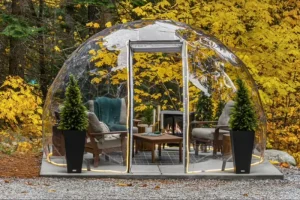
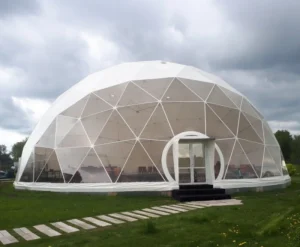
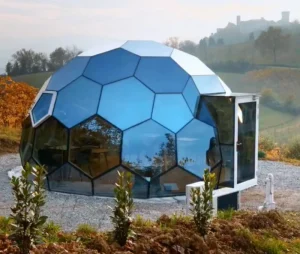
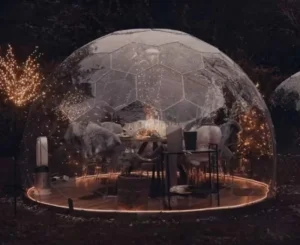
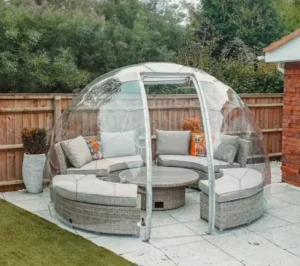
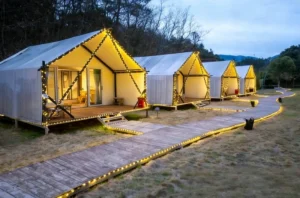
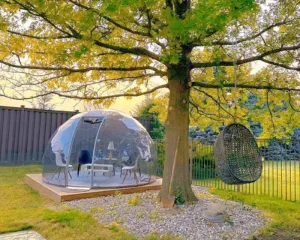
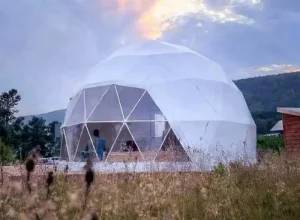
With their unique geometric aesthetics, superior energy efficiency and outstanding disaster resilience, geodesic dome homes are appealing to a growing number of people looking for innovative living solutions. From their strong hurricane-resistant construction to their unique design that harmonizes with nature, domes offer an experience that goes beyond traditional architecture.
An overview of the average cost of a geodesic dome home
Geodesic dome homes vary greatly in construction cost, depending on their size, choice of materials, luxury of interiors, and construction methods. As a result, it is difficult to give a simple fixed figure.
Typically, a basic, small (approx. 500-1000 sq. ft.) spherical geodesic dome home kit (including only the structure and exterior covering) can be in the range of 10,000 to 50,000. However, if built as a fully functional, finely finished living space, the total cost could easily be 75,000 to 300,000 or more. For large or highly customized luxury domes, it is not uncommon for costs to top $500,000.
This cost volatility stems from several core factors that collectively determine a project’s final budget.
Cost Comparison: Monolithic Domes vs. Spherical Domes
When exploring the cost of geodesic domes, we need to distinguish between two main types: monolithic domes and spherical domes . They differ significantly in their construction, performance and cost components.
Monolithic Domes
Definition and Characteristics: Monolithic Domes are typically constructed with airbag-supported concrete structures that are shotcreted or poured on-site to form a seamless, extremely strong monolithic shell. They are known for their exceptional resistance to hurricanes, earthquakes, tornadoes and even fire. Their thick shells and foam insulation provide superior energy efficiency, significantly reducing long-term operating costs.
Cost Features: Integral domes typically have a high initial investment. This is primarily because they require specialized foundation engineering, complex on-site construction processes (e.g., airbag installation, concrete shotcreting), and a team of specialized contractors. Rental costs for molds and specialized equipment can also add to the initial expense. However, due to their extremely low maintenance requirements and superior energy efficiency, the total cost of ownership is likely to be lower than that of a conventional home in the long run.
Who it’s for: Suitable for long-term residential projects seeking ultimate safety, durability, ultra-low energy consumption and low maintenance requirements, especially in areas prone to natural disasters.
Geodesic Domes
Definition and characteristics: Spherical domes consist of a large number of triangular frames (usually timber or steel) formed into a spherical skeleton by means of connectors, which are then covered with a variety of exterior materials (such as wood shingles, metal panels, polycarbonate, or PVC membranes). They are favored for their unique aesthetics, flexible design and relatively fast erection. Their multi-faceted construction maximizes the use of natural light.
Cost characteristics: The initial investment for a dome is usually relatively low, especially if you purchase a kit and opt for DIY installation. Costs are strongly influenced by the framing material (timber is usually cheaper than steel), the covering material (PVC film is the most economical, glass the most expensive) and the grade of the interior finish. Transportation and on-site assembly is usually easier due to its modular nature.
Suitable for: Projects pursuing unique design, natural lighting, DIY willingness, relatively flexible budgets or as auxiliary functions such as vacation homes, studios, greenhouses, etc.
Summary of Key Cost Differences:
Feature | Monolithic Dome Home | Geodesic Dome Home |
Structure | Concrete cast-in-place/sprayed, seamless | Frame (wood/steel) + external cover material |
Strength/Resilience | Extremely high — resistant to hurricanes, earthquakes, and fire | High — wind resistant; fire and earthquake resistance depends on materials and design |
Energy Efficiency | Extremely high — excellent insulation | Good — depends on insulation and window choices |
Initial Cost | Higher — requires professional construction | Low to moderate — kits and DIY options available |
Ongoing Maintenance | Very low | Low — depends on exterior materials and climate |
Construction Difficulty | High — requires a professional team | Moderate — DIY or professional help optional |

Geodesic Dome Homes Price Per Square Foot Analysis
The average cost per square foot for a geodesic dome home usually ranges from 75 to 250, but this is only a very broad range. Actual prices can be significantly affected by the following factors:
Economies of Scale: Typically, the larger the home, the lower the cost per square foot tends to be. This is because some of the fixed costs (such as foundation, utility access, and core functional areas like kitchens and bathrooms) are diluted by the larger square footage.
Material and Finish Grade: This is the most important factor that affects the price of the unit.
Economy: If you opt for basic wood framing, PVC or canvas covering, and simple interior finishes (e.g., open layout, basic appliances), the cost per square foot may be closer to $75-$120.
Mid-range: With higher quality wood or steel framing, durable composite or sheet metal covering, mid-quality kitchens and baths, and basic HVAC systems, the cost per square foot may be in the range of High-end: With stainless steel framing, glass cladding, custom luxury finishes, high-end appliances, integrated smart home systems, and geothermal heating, the price per square foot can easily top $200 or more.
DIY or not: You can save up to 30%-50% or more on labor costs if you install the kit and do the interior work yourself. But it also requires the right skills, tools and time.
Location: Labor costs vary greatly from region to region, which directly affects the total cost. In addition, the cost of transporting materials and local permits and approvals can also have an impact on the price per square foot. For example, construction costs are typically higher in large metropolitan areas on the East and West coasts than in the Midwest.
Type of Foundation: Simple point foundations or wood decks are usually less expensive than full concrete slab foundations.
Geodesic Dome Home Cost Breakdown
Building a Geodesic Dome Home involves multiple phases and different cost items. Here’s a detailed cost breakdown:
1. Design & Planning Phase: $1,000 – $15,000+
Architect/Designer Fees: If you need a customized design or a complex interior layout, professional designers range from **1,000 to $10,000 or more** and are usually charged at 5-15% of the total project cost.
Engineered stractural analysis: To ensure the dome structure is safe and complies with local building codes, it can cost 500 to 3,000.
Permits & approvals fees : This is an unavoidable cost. Depending on the specific codes of your city or county, this may include zoning approvals, building permits, utility access permits, etc., ranging from hundreds to thousands of dollars. Complex projects may require an environmental assessment, adding additional costs.
2.Foundations $5,000 – $50,000+
Foundation selection depends on soil conditions, dome size, and local codes.
Simple Foundation/Wooden Deck: Ideal for small domes or storage uses, costing approximately $5,000 – $15,00*.
Concrete Slab Foundation: The most common and solid option, costing from $15,000 – $35,000 depending on size and thickness.
Helical Pile/Deep Foundation: In areas with poor soil conditions or where higher seismic resistance is required, costs can be as high as $20,000 – $50,000+.
Geological Survey: If soil conditions are unknown, a geological survey may be required for $500 – $2,000.
Excavation and Grading: Site preparation costs, depending on complexity may range from $1,000 – $10,000.
3. Structural Body: $10,000 – $200,000+
This is the most central cost of a geodesic dome, depending on the type and materials you choose.
Dome kits/prefabricated parts (spherical domes):
Basic kits (frame and exterior cladding only): Small kits may range from $10,000 to $30,000*.
Complete Kits (prefabricated with interior walls, windows, etc.): Medium-sized residential kits can range from 30,000 to 100,000.
Materials: Wood framing is usually less expensive than steel or aluminum framing.
Site built materials (monolithic domes or fully customized): Material costs for concrete, rebar, foam insulation, airbags, etc., can range from 50,000 to 150,000+.
Professional installation/ conatruction costs: If DIY is not an option, labor for a professional dome installation team is a major expense and may range from $20,000 to $80,000+ depending on the size and complexity of the dome.
4. Exterior Finish: $5,000 – $50,000+
Roofing Materials: Variety of choices, cost varies widely.
PVC or canvas membrane: more economical, $5,000 – $15,000
Asphalt shingles or metal panels: durable, costing $10,000 – $30,000.
Glass or polycarbonate panels: provide maximum light, but are the most costly and can be as high as $20,000 – $50,000+.
Windows and Doors: Quantity, size and material (energy efficient glass, custom shapes) have a large impact and can range from $300 – $1,500+ per window and $500 – $3,000+ per door.
Exterior Paint/Finish: Waterproofing, aesthetic treatments.
5. Interior Finishes: $20,000 – $150,000 +
This portion of the cost is the most flexible, depending on your budget and comfort requirements.
Walls and Partitions: Curved walls inside a dome may add to the difficulty and cost of construction. Plasterboard, wood paneling or other materials.
Flooring: Laminate, tile, hardwood floors, carpet, etc., ranging from 3 to 20+ per square foot.
Kitchen: cabinets, countertops, sink, appliances (stove, refrigerator, dishwasher). Budget kitchens may start at $5,000, high-end custom kitchens may be $30,000+.
Bathrooms: Sanitaryware, shower/tub, tile, plumbing. A basic bathroom may start at $3,000, multiple or luxury configurations may be $15,000+.
Interior Paint/Finish: Paint, wallpaper, etc.
Stairs/Mezzanine: If there is a duplex structure or mezzanine bedroom within the dome, this will add to the cost of materials and labor.
6. System installation: $15,000 – $60,000+
Plumbing, Heating & Electrical (MEP):
Plumbing (Water, Drainage): Connection to municipal system or installation of septic tank/well.
Electrical wiring: Includes outlets, switches, fixture wiring and distribution box installation.
Hot water system: Conventional water heater or instantaneous water heater.
Total may be $10,000 – $30,000+ depending on dome size and functional complexity.
Heating, Ventilation, and Air Conditioning (HVAC) Systems:
Central Air Conditioning/Heating: higher cost, may be $10,000 – $25,000+.
Split Air Conditioning or In-Floor Heating: more flexible, cost varies by system and zone.
Due to the superior thermal properties of domes, their HVAC systems may be smaller and more energy efficient than a traditional home of the same size.
Lighting: Indoor and outdoor fixtures from 1,000 to 5,000+.
Smart Home Systems (optional): Additional incremental cost, from $1,000 to $10,000+.
7. Other Costs: $5,000 – $30,000+ (or more)
Transportation Costs: Costs of transporting materials and kits from supplier to job site, especially for remote areas or large kits, can be as high as $2,000 – $10,000+.
Equipment Rental: Cranes, scaffolding, excavators, etc. can be $1,000 – $5,000+.
Site management & supervision: If a project manager is hired, his/her fee may be charged at 10% – 20% of the total project cost.
Inaurance : Liability and property insurance during construction.
Landscaping: Perimeter roadways, landscaping, fencing, etc., very flexible from 2,000 to 20,000+.
Accident & reserve fund: It is highly recommended that 10%-15% of the total project budget be set aside as a reserve fund for unforeseen circumstances that may arise during construction.

Deeper Factors Affecting the Cost of Building a Dome Home
In addition to the meticulous cost breakdown above, there are several deeper factors that can significantly affect your final budget:
Geographic Location
- Labor Costs: Regional levels of economic development, union strength, etc. can lead to significant variations in labor costs.
- Material Accessibility and Freight: Proximity to major material suppliers or ports can directly impact transportation costs.
- Local Codes and Climate: For example, high seismic or wind pressure zones require stronger structures and materials, which can increase costs; colder regions require more insulation.
Degree of customization
- Standardized Kits vs. Fully Customized: Buying a proven standardized dome kit is often more economical than starting from scratch with a fully customized design and construction. Customized designs mean higher design fees, more complex construction, and higher material waste.
- Unique Feature Requirements: If you want to include unique features such as swimming pools, multi-story structures, observation towers, or oversized skylights in your dome, these can significantly increase the complexity and cost of design and construction.
Construction Methods (DIY vs. Specialty Contracting):
- DIY: If you have the construction skills, time, and the right tools, DIY can result in significant labor cost savings. However, it also means you are responsible for all construction management, quality control and risk.
- General Contractor: Hiring a general contractor provides a one-stop shop where they take care of all construction aspects and subcontractor management. Although it saves you money and effort, they will charge 10-20% of the project management fee and profit.
- Subcontracting Model: You act as the main contractor and hire separate specialized subcontractors (e.g. foundation, structure, plumbing, electrical, etc.). This may be more economical than general contracting, but it requires you to invest a lot of time in coordination and management.
Quality and Brand of Materials
Construction materials are available in the market in a wide range of quality and price. Choosing high-end, environmentally certified, or well-known brand name materials can significantly increase costs, but usually means better durability, performance, and aesthetics.
Energy efficiency goals
If your goal is to build a dome that meets “zero energy” or “passive house” standards, you’ll need to invest more money initially in insulation, high-performance windows and doors, heat recovery ventilation systems, and high-efficiency HVAC equipment. While this adds to the upfront cost, it can lead to significant energy savings in the long run.
Final Words
Building a geodesic dome home is an exciting journey, but its cost is truly a multivariate function that depends on a complex combination of factors. There is no “one size fits all” average cost and every project is unique.
For this reason, we highly recommend conducting thorough market research, obtaining detailed quotes from multiple suppliers and contractors, and consulting with an experienced dome building professional before embarking on a project. Make the most informed decision based on your actual needs for size, functionality, aesthetics, performance (e.g., energy efficiency and disaster resistance), and DIY capabilities, combined with your budget. A well-planned and detailed budget will be the key to the success of building your dream dome home.