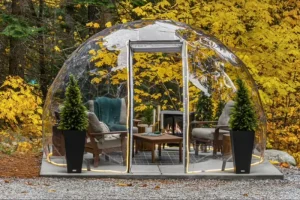
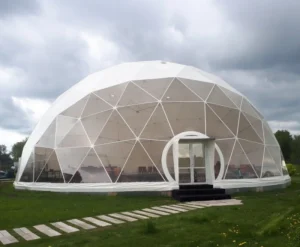
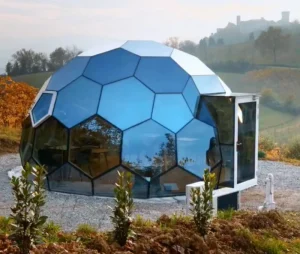
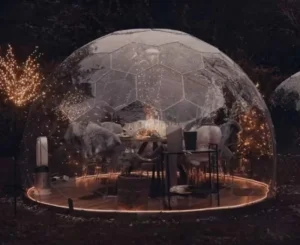
The price of a complete 7-meter geodesic dome tent typically ranges from US$2,500 to over US$21,000.
The difference mainly depends on three factors: the basic tent structure (frame + PVC), additional configurations (insulation lining, doors and windows, flooring, bathroom, etc.), and transportation, installation, and interior design.
The basic model is suitable for short-term camping, the mid-range configuration is suitable for guesthouses and campsites, and the high-end full configuration is suitable for commercial glamping projects.
Below, we will provide a comprehensive analysis of the 7-meter geodesic dome tent, from its basic structure and functional upgrades to the final cost, giving you a complete and systematic understanding of the price. This will help you choose the model that suits your budget.
What is a 7-meter geodesic dome tent? What scenarios is it suitable for?
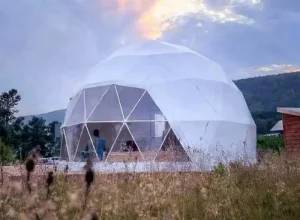
The 7-meter geodesic dome tent is one of the most popular luxury camping sizes globally
Its advantages include:
- 38–50㎡ usable area
- Accommodates 2–4 people or a small family suite
- Good airtightness, suitable for year-round use
Strong visual impact, suitable for guesthouses, glamping, scenic spots, farms, or seaside campsites
For most resort campsites, the 7-meter dome tent is a highly cost-effective standard unit, providing a hotel-level experience while being easy to set up and maintain.
The three major cost components that make up the complete price
When we discuss how much a 7-meter geodesic dome tent actually costs, many people only focus on basic components such as the “frame + cover.” However, in reality, the price of a dome tent that can be truly put into use, withstand wind and rain, and guarantee a comfortable stay is determined by three interconnected cost components:
- Basic kit (core structure)
- Upgraded configurations necessary for a luxury camping experience
- Additional costs incurred during installation and operation
Below, we will break down each component to help you truly understand the price structure from the perspectives of “why it’s expensive” and “where the cost comes from.”
Analysis of the price of the 7-meter geodesic dome tent “basic kit”
This is the basic cost of each dome tent and determines its safety, service life, and wind resistance rating. It is a necessary choice. A basic kit typically includes:
- Frame (steel or aluminum alloy structure)
- PVC cover
- Ground sheet, fixing ropes, ground stakes, and other basic installation accessories
The price range is generally $2,500–$10,500 USD.
Why is there such a large price difference? The main reasons are the grade of materials used for the frame and the cover fabric.
1. Frame Material: The “skeleton” of the dome, a decisive factor in safety and lifespan
The frame is one of the most important parts of a dome tent, accounting for 30–40% of the total cost. The better the material and the thicker the pipe diameter, the more significant the difference in stability and lifespan.
● Q235 Galvanized Steel Pipe
This is the most common material on the market, widely used in many campsites due to its high cost-effectiveness.
Its advantages are:
- Stable structure and sufficient hardness
- Moderate cost
The basic galvanized layer provides a certain degree of rust protection
Very suitable for areas with relatively stable climates and moderate winds. If you want to set up a permanent campsite and don’t plan to frequently disassemble and reassemble it, this is an economical and practical option.
● Thicker Steel + Painting / Powder Coating / Anodizing Treatment
If your campsite is located by the sea, in humid mountainous areas, or faces severe weather such as heavy rain and strong winds, then basic galvanized steel is far from sufficient.
The upgraded steel offers:
- Stronger corrosion resistance
- Not easily corroded by sea breeze
- Extended service life by several years
The price will be 5–10% higher than ordinary steel pipes, but for campsites planning for “long-term operation,” this is a necessary investment.
● Aluminum Alloy Frame
The biggest feature of aluminum alloy is “rust-proof + lightweight.”
This type of frame is very suitable for:
- Exhibitions requiring frequent disassembly and assembly
- Mobile camping
- Coastal climates
Although the price is higher, the lightweight structure reduces transportation costs and makes future maintenance easier.
2. Cover Fabric: Determines the lifespan and living comfort of the dome
The cover fabric accounts for 25–35% of the cost and is a key component in protecting the dome against wind, rain, UV rays, and temperature differences.
● PVC Coated Polyester Fabric (Mainstream choice)
Its thickness is generally 650–1100g/m². Higher thickness means:
- Stronger tear resistance
- Higher wind resistance rating
- Longer service life
Simply put, high-density PVC is like a thicker layer of armor, significantly improving lifespan and stability.
● PVDF Self-Cleaning Coating (Premium Option)
If you want your tent to stay white, clean, and beautiful for a long time, then PVDF is a worthwhile investment.
Its self-cleaning coating can:
- Significantly reduce dust and dirt adhesion
- Maintain the dome’s appearance longer
- Automatically wash away dirt with rainwater
The price is about 1.5 times higher than basic PVC, but from a business operation perspective, it’s very cost-effective.
● Transparent PC / PMMA Star Windows
If you want to create a “starry sky dome” or “panoramic view room” effect, then transparent windows are a must-have.
They not only enhance the visual experience but also upgrade the dome from an ordinary tent to a “trendy accommodation.”
Key Upgrades for a Luxury Camping Experience
Many users think that “you can live in a dome tent as soon as you buy it,” but what truly makes guests willing to pay is the supporting upgrades such as temperature control, doors and windows, and ventilation.
1. Insulation and Lining System: The Core of Four-Season Operation
Without an insulation system, dome tents will have serious problems:
- The interior will be stiflingly hot in summer
- It will be impossible to keep warm in winter
- Condensation will form on the inner walls and drip constantly
This will prevent guests from staying comfortably and may also damage the interior furniture.
The requirements for insulation systems vary in different regions:
- Cold regions: require thick insulation cotton + multi-layer aluminum foil insulation
- Humid regions: anti-condensation lining is almost a “standard”
The price is generally between $1,200 and $3,000 USD, but this is one of the configurations you shouldn’t skimp on.
2. Door and Window System Upgrade: The Key to Changing the Living Experience
Basic models usually only have soft fabric doors and small PVC windows, suitable for short-term camping.
But if you plan to operate commercially, a durable door and window system will significantly improve guests’ sense of security and comfort. Common upgrades include:
- Aluminum alloy glass doors: More windproof, rainproof, and smoother operation.
- Panoramic transparent windows: Offering unobstructed views of the surrounding scenery.
- Ventilation windows: Maintaining healthy air circulation indoors.
Glass doors typically cost $800–$1,500 USD, but significantly improve overall quality.
3. Ventilation system: Small investment, big improvement
Exhaust fans, louvered vents, and other equipment can prevent moisture buildup, reduce condensation, and ensure proper indoor air circulation.
Upgrade costs typically range from $100–$500 USD.
Additional Costs for Installation and Operation
1. Transportation and Customs (5–15% of total cost)
Due to the large size and weight of geodesic dome tents, transportation costs vary greatly depending on the region.
Cross-border orders also require expenses such as customs duties, customs clearance, and port charges.
2. Foundation and Platform Construction ($1,000–$5,000+)
Many users overlook the importance of the foundation.
A good platform can:
- Keep the dome level and stable
- Prevent water accumulation during the rainy season
- Enhance overall aesthetics and comfort
Common platform options:
- Gravel or flagstone (lowest cost)
- Pressure-treated wood platform (best value for money)
- Concrete foundation (most stable, but also the most expensive)
3. Utilities, Bathroom, and Interior Decoration (most variable cost)
This part of the cost varies depending on the campsite’s positioning.
You may need:
- Electricity and water connection
- Bathroom module ($2,000–4,000 USD)
- Furniture, lighting, and decorations
This is the cost area where “the biggest differences in budget” can occur.
How to Choose and Save Based on Your Budget?
So, given a total budget range of $9,800 to $21,000+ USD, how do we make reasonable choices? Some of these costs are unavoidable, while others can be adjusted based on your budget.
Costs that should not be saved on:
- High-quality frame and heavy-duty cover: This is the foundation for safety and long-term use. If the structure collapses or the cover tears, the repair costs will far exceed the initial price difference.
- Insulation System: Insulation determines whether your 7-meter geodesic dome tent can operate year-round. If you can’t use it during peak season, it will directly impact your return on investment.
Potential Cost Savings:
- Installation Costs: If you are a DIY enthusiast and have 3-4 helpers, you can organize self-assembly and save on the cost of a professional installation team.
- Foundation Options: For a tight budget initially, you can choose to lay flat flagstones or gravel as a foundation, and upgrade to a wooden platform later.
- Interior Amenities: Temporarily simplify interior decoration, for example, not installing a full kitchen, but only a simple tea/coffee corner.
Summary
In short, to purchase a profitable and comfortable four-season 7-meter geodesic dome tent, you need to prepare a budget of at least $15,000 USD (including a high-quality basic kit, insulation lining, and basic foundation).
The price reflects the extreme weather conditions your 7-meter geodesic dome tent can withstand, the level of luxury and comfort it can provide, and the long-term return on investment it can bring you. Clearly defining your operating environment and target customer group will allow you to make the most informed budget decisions.
In which region are you building your 7-meter geodesic dome tent? Which upgrade accessories are you most interested in? Share your budget and needs in the comments section, and let us provide you with more specific configuration suggestions!