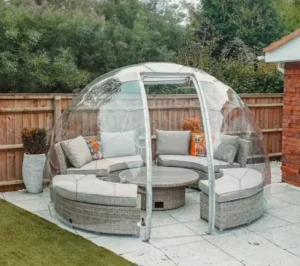
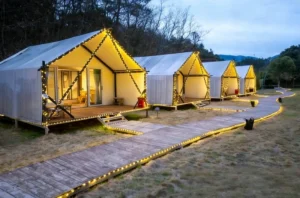
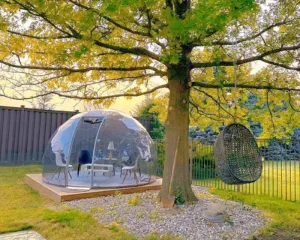
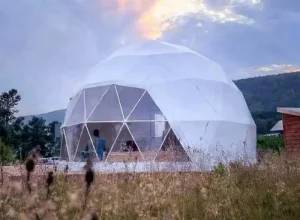
When you start planning a glamping project, you’ll often quickly encounter a practical question: what size geodesic dome tent is the right fit?
6 meters, 7 meters, 8 meters – these may seem like just numerical differences, but in reality, you’ll find significant differences in cost, guest experience, and operational methods. More importantly, successful campsites rarely use only a single size; instead, they use a reasonable combination of sizes to ensure the entire camp runs smoothly.
If you’re currently in the planning stage, this article will take you step-by-step through understanding the roles different dome sizes play in a glamping resort, based on real-world usage scenarios.
Why is it not ideal for a glamping campsite to use only one dome size?
Many first-time campsite investors instinctively think, “If I choose the most common size and use it throughout the entire camp, wouldn’t that be easier?” However, in actual operation, this approach often limits your spatial flexibility.
Different tourists have different expectations for space. Some only come for a relaxing weekend, while others stay for three or four days; some are more concerned about price, while others are willing to pay for the view and comfort. If all room types are the same, it’s difficult to meet all these needs simultaneously.
A reasonable combination of sizes essentially helps you segment your customer base.
What Dome Tent Sizes Are Commonly Used in Glamping Projects?
In numerous real-world projects, 6-meter, 7-meter, and 8-meter domes are the three most widely used sizes with the most mature supply chains.
They didn’t become popular randomly, but rather achieved a relatively ideal balance between spatial efficiency, structural stability, and commercial viability.
Simply put:
- 6 meters: Controls costs, increases quantity
- 7 meters: Main room type, ensures comfort
- 8 meters: Enhances the experience, creates memorable moments
Now, let’s look at each one individually.
6-Meter Geodesic Dome Tent
When you first step into a 6-meter geodesic dome, the immediate impression is often: the space isn’t large, but it’s not cramped, and it doesn’t feel oppressive.
This size is much like a carefully designed vacation cabin; all functions are arranged in just the right places, without unnecessary waste or compromise.
Space and Layout Experience
The usable area of a 6-meter dome is approximately 28㎡. In actual projects, even after placing a large bed, there is still ample space for basic activities.
With a reasonable layout, you can create a small seating area at the foot of the bed, placing a single sofa or a small round table for drinking coffee, organizing luggage, or even doing some simple work.
Many campsites choose not to include a complete bathroom inside the dome, but instead provide a centrally planned public bathroom area.
The advantages of this approach are very practical:
On the one hand, it significantly reduces the cost per unit, and on the other hand, it makes subsequent cleaning and maintenance more centralized and efficient.
Who is it best suited for?
Based on actual guest feedback, the 6-meter dome is very popular with the following groups:
- Couples or solo travelers
- Customers staying for only one night or a short weekend trip
- Those who are relatively price-sensitive but still want to experience the glamping atmosphere
These guests usually care more about the environment, atmosphere, and privacy than whether the room has too many functional areas.
Practical Role in the Campsite
In the overall campsite system, the 6-meter dome rarely plays the role of a “visual centerpiece,” but its importance cannot be ignored.
Its core value lies in: increasing overall occupancy rate and accelerating capital return.
If you are in the initial stages of campsite development and want to get the project up and running and test the market, then the 6-meter dome is often a very safe choice.
7-meter Geodesic Dome Tent
As campsite operations mature, you will find that many projects will coincidentally choose the 7-meter geodesic dome as a core configuration. This is not a coincidence, but a choice that naturally emerges after long-term use.
Space and Living Experience
The usable area of a 7-meter dome is nearly 38㎡. Upon entering, you will clearly feel that the space is “more open.”
In addition to the bed, you can more comfortably arrange sofas, a small dining table, or even a complete independent bathroom system.
This spatial scale allows the living experience to transition from “tent accommodation” to “holiday living.”
For tourists planning to stay for two or three nights, it feels more like a small holiday home surrounded by nature, rather than a temporary space.
Who is it best suited for?
In actual operation, the 7-meter dome is often one of the most popular tent types, especially suitable for:
- Couples or small families with children
- Users on weekend getaways or short vacations
- Guests with specific expectations for comfort and privacy
These guests are usually willing to pay a reasonable premium for a better living experience.
Positioning in the campsite
If the 6-meter dome is responsible for “volume sales,” then the 7-meter dome is key to stable cash flow.
It doesn’t significantly increase construction costs like larger sizes, but it has enough pricing flexibility to support mid-to-high-end prices.
For many glamping projects, this size often constitutes the “backbone” of the campsite.
8-meter Geodesic Dome Tent
The first time most people enter an 8-meter geodesic dome, they instinctively look up at the dome. The higher ceiling and wider view make the entire space stand out immediately.
Space and layout possibilities
The approximately 50㎡ usable area allows you to clearly divide different functional areas:
The sleeping area, lounge area, and bathroom are separate and do not interfere with each other, and the overall flow is more comfortable.
If combined with panoramic floor-to-ceiling windows or a top skylight design, this type of geodesic dome easily becomes a “star room type” that tourists actively photograph and share, naturally generating publicity on social media platforms.
Which usage scenarios are more suitable?
The 8-meter dome is usually more suitable for:
- Family trips or multiple occupants
- High-end couples, anniversary guests
- Honeymoons, anniversaries, and other special accommodation needs
- Small private gatherings or light activity spaces
It’s not just an accommodation unit, but a carrier of experience.
Significance in the campsite
In most campsites, the number of 8-meter domes is not large, but their presence is very strong.
They are often placed in the locations with the best views to enhance brand image and increase average customer spending.

Which Size Geodesic Dome Is Best for a Glamping Project?
In real project discussions, few people only ask “which size is best,” but rather discuss: how to combine different sizes to be both practical and easy to operate. A common and reliable combination logic:
- 6 meters: Increases overall bed capacity and enhances basic revenue.
- 7 meters: Serves as the main room type, stabilizing daily operations.
- 8 meters: Creates highlights, improving the overall tone and premium pricing potential.
For example, a glamping campsite with around 20 domes could consider:
- 6m × several (volume-selling room type)
- 7m × main quantity (stable revenue)
- 8m × a small number (image and experience)
This structure offers more flexibility in operation and marketing, and facilitates adjustments based on market feedback.
What Do People Often Overlook When Planning a Glamping Resort
Don’t just focus on “size”
Whether the space is functional is often more important than “how big it looks.”
Through reasonable layout and functional planning, a medium-sized dome can provide a better-than-expected living experience.
Consider long-term operation in advance
During the planning phase, you need to consider some more realistic issues:
- Is maintenance easy?
- Does it support functional upgrades?
- How comfortable is it to use in different seasons?
These issues usually only become apparent after the project has been running for a year, but the earlier you consider them, the easier it is to control risks.
Leave some room for the future
Many successful campsites start with a basic combination and gradually add high-end room types as operations mature.
If you make the structure too rigid from the beginning, it will limit the room for future adjustments.
FAQs about Geodesic Dome sizes
Q1: What is the most commonly used Geodesic Dome size for glamping campsites?
A: Currently, 7 meters is the most common standard size, balancing comfort and cost, and is suitable for most glamping projects as the main room type.
Q2: Is a 6-meter dome too small for long-term accommodation?
A: For short stays or couples, a 6-meter dome is perfectly adequate. The key is whether the layout is reasonable and whether it is used in conjunction with public functional areas.
Q3: Is an 8-meter dome necessary?
A: If you want to upgrade the campsite’s level and increase the average price per guest, an 8-meter dome is very valuable. However, it is not recommended to have too many; it is more suitable as a featured room type.
Q4: Should a campsite only choose one size?
A: Not recommended. Mixed sizes allow you to cover more customer segments and create a gradient in price and experience.
Summary
In glamping projects, there is no single “one-size-fits-all” optimal size.
What truly determines success or failure is often your campsite’s positioning, target audience, and how you envision it developing in the future.
In this process, choosing a reliable and experienced dome structure supplier is equally important.
Gaxdome is a professional geodesic dome tent manufacturer from China, specializing in the design and manufacturing of geodesic dome structures.
In actual projects, Gaxdome not only provides mainstream sizes such as 6-meter, 7-meter, and 8-meter dome tents, but can also customize sizes and structures more flexibly based on the terrain conditions, usage scenarios, and operational needs of different campsites.
For campsites that want to create a differentiated experience, a unified quality standard combined with a layered size combination can often subtly enhance the overall brand image, rather than making the campsite look like a simple collection of replicated accommodation units.
Choosing the right geodesic dome sizes is often just the starting point, not the end point, of a successful campsite.
Only when the basic structure is stable enough can you have the space to consider further upgrades in operations, services, and experiences.
If you are planning your own glamping project, it’s worthwhile to spend more time in the early stages thinking through the size, structure, and overall layout.
Often, getting this step right will make the rest of the process much easier.