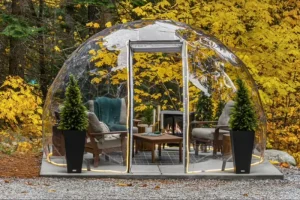
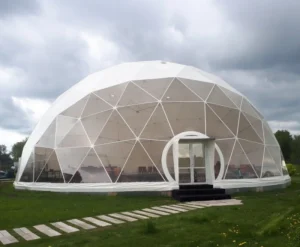
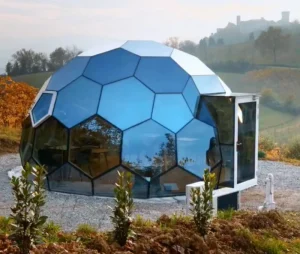
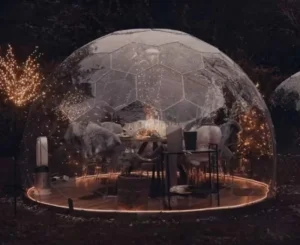
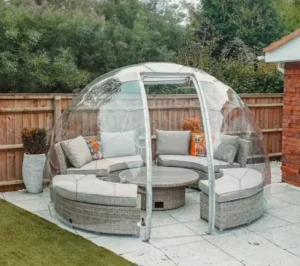
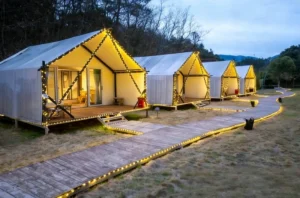
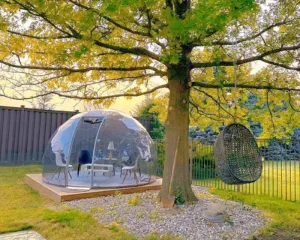
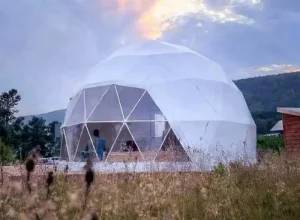
Outdoor igloo domes, when structurally stable and properly configured, can be used year-round. However, ordinary single-layer transparent domes are usually only suitable for spring, summer, and autumn, requiring additional insulation, ventilation, and temperature control equipment for winter and peak summer use.
Introduction
With the increasing popularity of outdoor lifestyles, Outdoor Igloo Domes are becoming an increasingly common outdoor structure in courtyards, patios, dining spaces, and glamping campsites.
They are transparent, uniquely shaped, and offer a strong experiential appeal. However, at the same time, many people have a very real question before considering purchasing or using one:
Are Outdoor Igloo Domes truly suitable for year-round use?
Especially—
Will it be too cold in winter, with severe condensation?
Will it be stiflingly hot like a greenhouse in summer?
This article won’t give you a simple “yes” or “no,” but will explain, based on structure, materials, configuration, and real-world usage scenarios:
Whether an igloo dome can be used year-round depends on whether you configure it to “year-round standards.”
Why are so many people concerned about whether Outdoor Igloo Domes can be used year-round?
In actual consultations, many people’s first reaction to Outdoor Igloo Domes is not whether they look good, but whether they are practical.
This question often stems from the most intuitive characteristic of the igloo dome—its transparent or translucent appearance.
Visually, outdoor igloo domes are mainly composed of transparent PVC or PC panels. These materials are usually associated with lighting, display, or temporary spaces, rather than long-term structures with insulation and heat resistance capabilities. Because of this, many users naturally worry:
Will it easily lose heat in winter? Will it overheat due to direct sunlight in summer?
This concern is particularly evident in actual usage scenarios. Whether it’s a private courtyard, outdoor dining booth, glamping campsite, or winter special event space, these applications are not just for one or two months, but are intended for year-round use. Under these circumstances, whether the transparent structure can balance comfort and safety becomes the most important question for users.
Therefore, “Is the Outdoor Igloo Dome suitable for year-round use?” is not a question about the product form itself, but a rational consideration of its actual use experience in different seasons. This is precisely why further explanation from the structural and configuration aspects is needed.
Is the Outdoor Igloo Dome itself suitable for year-round use?
Before discussing configurations, it’s necessary to clarify a prerequisite: the Outdoor Igloo Dome, from a structural perspective, is not incompatible with year-round use.
Structurally, the dome itself is better suited for long-term outdoor environments
From an engineering perspective, the dome is a very mature structural form widely used in long-term outdoor construction. Compared to tents or lightweight shelters with vertical walls, the dome distributes stress more evenly, making it more stable in the face of natural conditions such as wind, rain, and snow.
For example, in high winds, the dome structure can effectively disperse wind pressure; in snowy conditions, snow does not easily accumulate on the top but slides off naturally, reducing the risk of structural stress. Because of these characteristics, many long-term outdoor structures in extreme climate regions use dome or curved structures.
From this perspective, the igloo dome is not only not incompatible with year-round use, but actually possesses certain inherent advantages.
From a materials and configuration standpoint, not all Igloo Domes are “four-season” models.
It’s important to note that structural advantages do not equate to “ready for four-season use out of the box.”
In the actual market, the design intent of outdoor igloo domes is not entirely consistent. Some products are more geared towards short-term or seasonal use, such as lightweight PVC bubble structures or single-layer transparent designs. These products are visually very appealing, but often have limitations in terms of insulation, ventilation, and wind and snow resistance.
Without additional structural reinforcement or functional configurations, these types of igloo domes are difficult to maintain a good user experience in winter or mid-summer environments.
Therefore, judging whether an igloo dome is suitable for year-round use requires looking beyond just the “dome” appearance and considering whether it supports subsequent four-season configuration options.
What key configurations are needed for winter use?
For most users, winter is often the critical stage for testing whether an igloo dome is truly “year-round usable.”
What practical problems are usually encountered during winter use?
In actual projects, the most common challenges in winter mainly focus on three aspects:
First, rapid heat loss in low-temperature environments; second, condensation problems caused by temperature differences between inside and outside; and third, the test of overall structural stability in windy and snowy weather.
If these problems are not effectively addressed, even if the structure itself is stable enough, the user experience will be significantly compromised. Key Configurations Not to Be Overlooked for Winter Use
The insulation system is the core of winter configurations
By using a double-layer structure, adding an inner layer of insulation material on top of the outer transparent material can significantly improve insulation performance and reduce condensation. Common inner layer forms include insulated liners, padded layers, or aluminum foil insulation layers. In practical use, this structure can often increase the perceived temperature by 5–10℃.
In addition to insulation, a reasonable heating method is equally important. For home or garden use, electric heaters or electric fan heaters are usually sufficient; while in commercial or glamping projects, dedicated tent heaters are more commonly used, often in conjunction with ventilation and exhaust systems. It is important to note that using ordinary open flames for heating inside the igloo dome is not recommended to avoid potential safety hazards.
Furthermore, even with a dome structure, fixing and windproofing measures should not be overlooked in winter. Strengthening overall stability through ground bolts, ground stakes, or foundation fixing methods is an important prerequisite for safe use in winter.
The last often overlooked detail is ventilation and condensation control. The biggest problem many users encounter in winter is not insufficient temperature, but rather severe condensation affecting the experience. By providing controllable ventilation openings at the top or sides, and combining this with the double-layer structure to form an air isolation layer, this problem can be effectively improved.
Will it be too hot in summer? How to improve the experience?
Corresponding to winter, summer is another common concern. Many people believe that a transparent igloo dome will be very stuffy in the summer, but in reality, this is more often a problem caused by insufficient configuration.
Why is it easy to feel stuffy in summer?
Transparent materials easily create a greenhouse effect under direct sunlight, and coupled with the natural tendency of hot air to accumulate at the top, if the ventilation design is insufficient, the indoor temperature will indeed rise significantly.
The key to comfortable summer use is “actively managing heat.”
In practical use, ventilation is always the top priority for summer configurations. Effective air convection can be achieved through openable doors and windows, top heat vents, or side ventilation structures. In commercial projects, exhaust fans or electric skylights are also commonly used to improve ventilation efficiency.
At the same time, shading and UV protection configurations have a very significant impact on the summer experience. Whether built-in or external sunshades are used, combined with UV-resistant transparent materials, they can significantly reduce the heat from direct sunlight. Simply adding sunshades can typically lower the perceived temperature by 6–10℃.
In hot or humid regions, industrial fans, evaporative coolers, or portable air conditioners can be used in conjunction with the dome, depending on the actual climate conditions. Through a reasonable combination, the igloo dome can remain comfortable even in summer.
Seasonal Configuration Suggestions for Different Usage Scenarios
Different usage scenarios have different requirements for seasonal configurations.
For courtyard or home leisure use, a basic double-layer structure, simple heating equipment, and basic ventilation and shading configurations are usually sufficient. The focus is on safety, energy efficiency, and ease of daily maintenance.
In glamping campsites or commercial projects, due to higher usage frequency and longer operating cycles, the requirements for configuration are correspondingly higher. These scenarios usually require a complete insulation system, professional heating and exhaust design, a more stable structural fixing method, and higher-grade ventilation and shading solutions to ensure long-term stable operation and a good user experience.
For short-term event use, modular and quick-installation configurations are more suitable; while for long-term installation projects, it is recommended to plan the basic fixing and systematic configuration from the beginning.
How to determine if an Outdoor Igloo Dome is truly suitable for all four seasons?
Before actually purchasing or planning an Outdoor Igloo Dome, many people encounter a problem: almost all products on the market claim to be “suitable for year-round use,” but the actual experience varies greatly. This is because year-round suitability is not just an appearance label, but a comprehensive capability encompassing everything from structure to configuration.
The first step in determining suitability for all four seasons is to see if the design allows for upgrades, rather than being a fixed solution only suitable for a single season.
A truly four-season-capable igloo dome usually doesn’t stop at a single-layer transparent structure. Whether it supports a double-layer structure and whether it can form an effective air insulation layer directly determines its comfort limits in winter and summer.
Equally important is the feasibility of heating and ventilation. If you want to add heating, ventilation, or cooling equipment later, but find that the structure itself cannot accommodate it, then even if the appearance looks complete, it will be difficult to achieve true year-round use.
Besides comfort, safety is often overlooked. Year-round use means enduring repeated tests of wind, rain, snow, and high temperatures. Therefore, whether the wind and snow resistance is clearly defined and whether the fixing method is suitable for long-term installation will directly affect user confidence. Compared to a vague statement like “sturdy and durable,” clear structural standards and a stable installation plan are the truly reliable criteria for judgment.
Conclusion
The outdoor igloo dome is not a “one-size-fits-all” product, but rather an outdoor space system that can be configured and upgraded according to usage needs.
- In winter, the key is insulation and safety;
- In summer, the core is ventilation and sun protection;
True year-round use depends on a comprehensive plan that is rationally designed from the very beginning.
If you are planning for long-term use, commercial operation, or scenarios with high demands on comfort, it’s better to consider the “year-round standards” from the start, rather than constantly making adjustments later.
To learn more about our Outdoor Igloo Dome solutions suitable for all seasons, or to customize a configuration for your specific needs, please contact us. The professional team at Gaxdome can provide a complete solution, from structural design and material selection to seasonal configurations, ensuring your igloo dome is safe and comfortable to use year-round.