If you’re considering buying or setting up a geodesic dome, you might ask a very practical question: **Does it need a foundation?**
If you’re new to geodesic domes, you might assume they require a full concrete foundation like traditional buildings. This isn’t the case. Geodesic domes typically don’t need a “traditional foundation” because they are essentially portable, lightweight structures.
What you really need is a stable platform or a reliable anchoring system to ensure the dome remains stable and safe under various ground conditions.
The Difference Between Foundation and Anchoring
Definition and Function of a Traditional Foundation
Generally, a traditional foundation refers to a deep concrete structure poured for traditional brick-and-mortar or heavy steel structures. Its main purpose is to evenly distribute the building’s enormous weight, prevent settlement (anti-settlement), and provide a stable, level foundation. Such foundations often involve extensive excavation, rebar, and concrete work, which is time-consuming and costly.
Definition and Function of a Geodesic Anchoring System
However, the geometry of a geodesic dome is lightweight and stress-balanced. Its weight is evenly distributed across every connection point in the base, thus eliminating the need for a heavy foundation to withstand the immense vertical pressure.
What a dome requires is a professional and reliable anchoring system. The core function of this system is not load-bearing, but rather to resist the uplift force and lateral thrust generated by wind. Imagine a strong wind attempting to lift the structure off the ground; the anchoring system acts as the large hands that firmly hold the dome in place.
Why Doesn’t a Geodesic Dome Tent Need a Traditional Foundation?
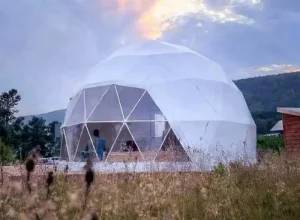
The structure of a dome tent relies on triangular supports, resulting in a very even weight distribution. Therefore, unlike traditional buildings, it doesn’t require a rigid foundation to bear the load.
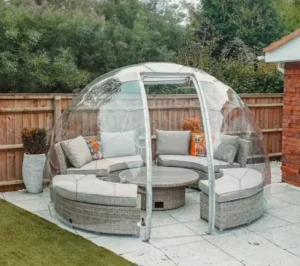
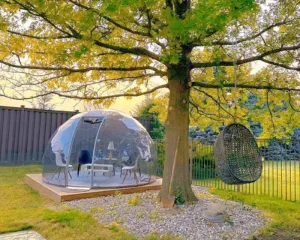
Whether you place it on grass, sand, a wooden platform, or even a concrete surface, it can adapt.
Furthermore, because it is a “temporary + movable” structure, excessive construction would only increase costs and reduce flexibility. Therefore, you should focus more on “how to stabilize it” rather than “whether to pour a foundation.”

Common Non-Traditional Foundation Fixing Methods
Now that you know dome tents don’t rely on traditional concrete foundations, the next important step is choosing the right fixing method for your site. Different environments require different anchoring solutions, so we’ve summarized the most common non-traditional fixing methods to help you quickly determine which option fits your needs best.
Common Non-Traditional Fixing Methods for Geodesic Dome Tents
| Fixing Method | Applicable Scenarios | Advantages | Precautions |
|---|---|---|---|
| Ground Pegs / Anchors | Grass, soil, mud | Simple, fast, low-cost | Cannot be used on hard surfaces; alternatives needed. |
| Ropes / Guy Lines | Temporary events, camping | Flexible, easy to adjust | Must maintain even tension to avoid tilting. |
| Sandbags / Ballast Weights | Terraces, concrete, hard ground | No drilling, easy to relocate | Requires sufficient weight in strong winds. |
| Wood or Steel Platforms | Hard surfaces, exhibitions | Stable, reusable | Slightly higher cost; manpower needed for relocation. |
| Spiral Stakes / Fixed Bases | Long-term or commercial use | Very stable, strong load-bearing | More complex installation. |
Four Core Factors Determining Anchoring Needs
To determine what level of anchoring solution your dome needs, you must consider the following four crucial factors. These factors directly affect the structure’s load-bearing capacity and safety requirements.
Dome Span/Dimensions
Undoubtedly, the size of the dome is the primary factor affecting anchorage strength. A small dome with a diameter of only $5m has a completely different wind load and weight compared to a large exhibition hall dome with a diameter of $20m.
As the span increases, the cross-sectional area exposed to wind forces increases dramatically, and the pull-out resistance requirements of the anchorage points also increase exponentially.
Usage Duration and Purpose
How long do you plan to use it? If you are only hosting a temporary market display for a few days, simple ballast may suffice. However, if your dome is intended as a seasonal outdoor restaurant or a permanent holiday cabin, you must choose a professional anchoring solution that can withstand various extreme weather conditions for many years, prioritizing safety.
Installation Ground Type
Different ground materials have a decisive impact on the difficulty and method of anchoring. Hard ground (such as concrete and asphalt) can be efficiently anchored by drilling and bolting; while soft soil, grass, or sand requires more specialized anchoring tools that can penetrate deep into the ground, such as helical piles, to obtain sufficient grip.
Local Climate Conditions
The most important thing is to understand the climate conditions and local building codes of the site where your geodesic dome will be installed. If the area often faces strong typhoons or heavy snowfall in winter, the anchoring system and overall structural design of the dome must be even more rigorous.
Before construction begins, engineering teams need to perform professional calculations for wind load and snow load to ensure the dome meets local building standards. Only after passing these engineering evaluations can your geodesic dome be approved for long-term and safe use.
Foundation Requirements for Dome Tents in Different Scenarios
Temporary Events and Light Camping
If your dome is only used for a weekend party, a temporary market display, or a short-term outdoor camping trip, then you are looking for extremely quick setup and easy dismantling, naturally requiring minimal damage to the foundation.
In this scenario, foundation requirements are minimal; our primary goal is to prevent the structure from being blown away by light winds or accidentally toppled. Therefore, you can choose simple and flexible ballast solutions.
For example, directly using heavy objects for ballast, such as water-filled bags, sandbags, or small concrete blocks placed around the base, is feasible.
Of course, if you are building the dome on grass, using long, sturdy ground pegs to firmly connect the base to the ground will usually meet the safety requirements for temporary events.

Seasonal Accommodation and Outdoor Commercial
However, if your dome plans to upgrade to an outdoor restaurant, glamping holiday home, or seasonal educational facility, requiring stable operation for months or even years, then you must take foundation issues seriously.
At this point, stability requirements have increased to medium to high. Your structure must be able to withstand strong summer winds, continuous rainfall, and even sudden storms, ensuring the 100% safety of people and property inside. Therefore, the anchoring solution must be reliable and durable, maintaining a secure hold for extended periods.
To meet this need, you will need to introduce specialized anchoring components. If your site is a hard, flat concrete or asphalt surface, you can directly use expansion bolts, or stronger chemical anchors, to firmly “rivet” the metal base frame of the dome to the ground—efficient and stable.
However, if your site is soft ground such as grass or soil, ordinary bolts will not work. In this case, we strongly recommend using professional screw piles. They can be screwed deep into the ground like giant screws, providing strong pull-out resistance, ensuring structural safety, and are very environmentally friendly due to minimal environmental impact during dismantling.
Large Exhibition Halls and Permanent Storage
When your dome structure is upgraded to a large exhibition hall, industrial storage space, or even planned as permanent residence, the situation is very different. At this scale, the requirements for structural safety and service life are extremely high, often requiring guarantees for years or even decades.
Therefore, the foundation requirements naturally reach the highest level; it must be a permanent foundation calculated by structural engineers and meeting the most stringent local building safety regulations. Faced with such enormous loads, the intervention of structural engineering is a necessary step.
In this situation, the optimal solution is not the traditional deep foundation digging, but rather pouring a ring foundation. This is a concrete “ring beam” of moderate width and sufficient thickness, providing a perfect level surface and substantial self-weight ballast for the dome base, effectively isolating it from ground moisture, and serving as the cornerstone for long-term stable use.
Of course, if you want both permanent stability and future mobility, you can choose another flexible alternative: first, build an adjustable heavy-duty steel structure base platform. Then, secure this robust platform to the ground using a strong ground anchoring system. In this way, the platform itself becomes a stable and removable “super foundation,” balancing safety and flexibility.
How to Choose the Anchoring Method for a Geodesic Dome?
When installing a geodesic dome, ground conditions often determine the final anchoring method. Although the dome structure itself is very stable, it still requires selecting the correct anchoring method based on the site characteristics to maintain safety and reliability during long-term use or in severe weather. You can think of it as finding the most suitable “foothold” for the dome: different ground surfaces require different methods to secure it firmly.
Hard Ground : Concrete/Asphalt
If the dome tent is to be erected on hardened concrete or asphalt, congratulations—this is the easiest type of ground to install on. You only need to use expansion bolts or chemical anchors to directly fix the connecting pieces of the dome base to the ground.
This method has the advantages of fast construction, structural stability, and even stress distribution, making it ideal for commercial events, exhibitions, or projects requiring rapid on-site access. For dome structures with large spans, bolt anchoring is even more advantageous, making the entire dome appear as if it’s grown into the ground.
Soft Ground : Grass/Mud
If the dome tent is to be erected on mud, grass, farmland, or sand, traditional expansion bolts will not work. In this case, a more professional ground anchoring system must be relied upon to allow the dome to firmly “grip” the soft ground.
Deep Ground Anchors
These anchors are similar to larger, stronger ground stakes, driven deep into the ground using specialized tools. Their “grip” provides the dome with excellent wind resistance.
Helical Pile
A more advanced option is the helical pile, which, like a large auger, is screwed into the ground, providing extremely high pull-out resistance. It is particularly reliable for dome tents with large spans and high wind load requirements.
More importantly, it causes almost no damage to the ground after removal, making it ideal for campsites, scenic areas, and projects with high environmental requirements.
Uneven Ground
If the location for setting up the dome tent is uneven, such as mountainous terrain, slopes, or old, vacant land, the dome cannot be placed directly on it. Uneven stress will lead to structural instability.
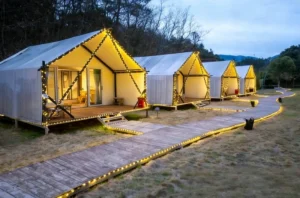
In this case, the most professional and safest method is to build an adjustable wooden or steel platform. This platform not only provides a perfectly level surface but also:
- Improves structural stability (even stress distribution)
- Reduces moisture penetration (better for long-stay campsites)
- Improves ground comfort (better for guesthouse or hotel-grade domes)
- Enhances overall aesthetics (the platform makes the dome feel more spacious).
For high-end glamping and long-term operating dome projects, a platform is almost standard equipment.
Summary
For geodesic domes, the “foundation” is not a traditional concrete base, but any base, platform, or anchoring system that ensures the tent’s stability.
Choosing the right anchoring method ensures your geodesic dome is stable and secure in various environments while maintaining a degree of mobility and flexibility.