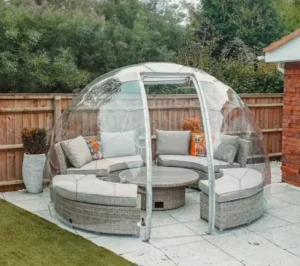
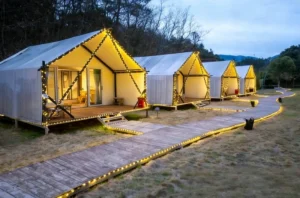
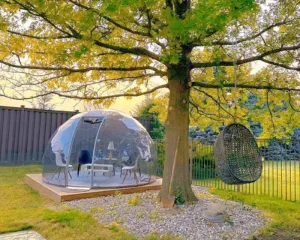
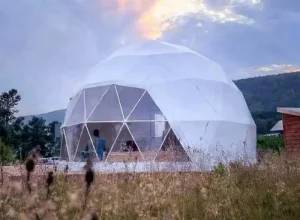
Winter backyards always inspire romantic ideas.
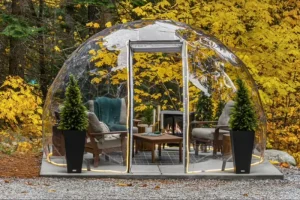
For example, building a transparent PVC Igloo Dome, placing a few small chairs inside, a pot of hot cocoa, watching the snow, chatting, daydreaming… Sounds lovely, right?
But before you get too excited and grab your tools, there’s one crucial thing to clarify first: is this even legal where you live?
Is It Legal to Build a PVC Igloo Dome in Your Backyard — and Could You Be Fined?
Regulations vary widely by location. In most areas of the US, structures that are “temporary, movable, and not permanently attached to the ground” are generally permitted without a building permit, and small domes (under 100 square feet) typically don’t require one.
However, if you want to build something larger or taller, or plan to keep it there long-term, you may need to go through the approval process.
Europe has stricter regulations. For example, in the UK, almost all non-residential structures require planning permission; in Germany, you may even need to prove how much wind the dome can withstand or whether it can remain stable in snow.
So, the safest approach is:
Contact your local municipal department directly, or use a zoning code lookup tool like Zola to check first. Don’t take chances—some homeowners try to cut corners, only to receive a notice to rectify the issue later, along with a fine of several thousand dollars. The romance doesn’t materialize, and you end up with a headache.
Is Your Backyard Suitable for Building a PVC Igloo Dome?
PVC domes are sturdy, but they are not a one-size-fits-all solution. Whether they are suitable depends on your climate and the condition of your backyard.
If you live in an extremely cold region, such as Canada or Scandinavia, you must choose PVC that is resistant to low temperatures. Otherwise, when temperatures drop below -30°C, cheaper materials may crack.
In windy areas, such as coastal regions or open plains, you should consider using reinforced aluminum frames that can withstand winds of 100 kilometers per hour, so you won’t wake up to find the dome has “flown away.”
In areas with high humidity and frequent rainfall, you should choose PVC with both UV resistance and waterproof certification, otherwise it will become brittle and fade in no time.
As for the ground, if it is soft clay, it is best to lay a layer of gravel (approximately $100 to $300) or pour a concrete slab (approximately $500 to $1,500) first to ensure stability. If the ground is firm, you can build directly on it, but adding a moisture-proof pad will provide added peace of mind.
Building a PVC Igloo Dome in the backyard isn’t that difficult, but making it both legal and able to withstand the winds, frost, and snow under your local sky is the real challenge.
First, check the regulations, then select materials suitable for the local climate, and finally, don’t forget to ensure the foundation is stable—this way, you can truly enjoy watching the snow in that transparent dome in peace, rather than worrying about having to tear it down tomorrow.
What Preparations Need to Be Made Before Constructing a PVC Igloo Dome?
Before deciding to build a PVC Igloo Dome yourself, you need to make thorough preparations. This is not just about purchasing materials, but a systematic planning process. If you search Google for **“PVC dome tutorial” or “DIY dome checklist”**, you will find that the following steps are essential:
Site Planning and Permits: First, you need to assess whether your backyard is flat and has sufficient space. Additionally, you must review the local regulations mentioned earlier to ensure your project is legal.
Design and Calculations: This is the most critical step. You need to determine the dome’s dimensions (diameter, height) and calculate the exact length and quantity of PVC pipes required, as well as the type and quantity of connectors. This typically requires the use of a professional dome calculator, as even minor errors can prevent the structure from assembling properly.
Material Procurement: Based on the calculations, you need to purchase sufficient quantities of PVC pipes, connectors (hubs), screws, nuts, and transparent plastic film or waterproof fabric to cover the dome. This step requires a clear understanding of the specifications and quality of the materials.
Tool Preparation: You need to prepare a measuring tape, PVC pipe cutter or saw, electric drill, wrench, and other tools.
After completing these preparations, you can proceed to the cutting and assembly phase. However, this process is far from as smooth as imagined.
Is Building a DIY Dome Snow House a Challenge or a Trap?
Have you also noticed some DIY dome snow houses? I believe many of you have watched related video tutorials, but when you try to build a dome structure yourself following the video instructions, you’ll find it’s not that simple. You may encounter various issues during the construction process:
Complexity of Calculations
Drawing a beautiful dome diagram on paper may seem straightforward, but when you actually start building it, you’ll find that problems arise one after another. A dome is a geometric structure composed of numerous triangles. The length of each PVC pipe and the deviation of each angle will be magnified during final assembly—even a difference of just a few millimeters could cause the entire frame to fail to align properly or become crooked. For most people without engineering measurement experience, this level of precision is almost a nightmare, requiring repeated measurements and cuts, which may take several days.
Material limitations
PVC pipes are convenient for everyday use, but winter is no joke. You may underestimate the force of strong winds or the weight of snow—when a blizzard hits, ordinary PVC pipes and connectors may bend or even break. If the dome is temporary, it’s still manageable to dismantle it; but if you’re hoping to keep it up for the entire winter, you’ll need to be cautious about it being blown apart by the wind in the middle of the night.
Assembly Challenges
Don’t assume that having a tutorial will guarantee success. The DIY dome process involves a repetitive cycle of cutting, drilling, and securing, requiring not only patience but also tools like saws and drills capable of handling PVC. First-timers often end up with misaligned holes or loose connections, resulting in an unstable structure. You might spend an entire weekend and still be stuck at the “half-finished” stage.
Discrepancy in Appearance
In imagination, the dome is crystal clear and resembles an art installation. But in reality, the seams, screws, and connectors of PVC pipes are hard to completely hide. Hand-cut pipes may not be perfectly flat, and connection points may be uneven. The final assembled structure often falls short of the initial romantic vision. At that moment, you realize—the dreamy dome in the photo is actually the work of a professional team.
Therefore, for a backyard space that requires long-term use and must ensure safety, while a DIY dome snow house is feasible, it is fraught with uncertainty and potential risks.
Gaxdome Solves Your Installation Problems
We deeply understand your desire for a winter wonderland. Based on our insight into the challenges of DIY, Gaxdome offers you a smarter, more reliable solution—a professionally designed dome snow house.
We are committed to transforming complex engineering into simple products, allowing you to enjoy a perfect backyard space without the risks and hassles of DIY.
Safety and Stability, Professional Assurance: Gaxdome’s domes feature rigorous mechanical design and high-quality materials, capable of withstanding harsh weather conditions, ensuring the safety of you and your family.
Time-Saving and Effortless, Easy Installation: We use a modular design, with all components pre-fabricated and precisely cut. Simply follow the detailed instructions to assemble in a short time, eliminating the hassle of DIY.
Elegant appearance, exceptional quality: The Gaxdome dome snow house features sleek lines and a modern design, seamlessly integrating into your backyard environment to create a unique landscape. Additionally, the high-quality transparent canopy provides excellent light transmission, allowing you to fully enjoy the winter sun.
Summary
Therefore, returning to the original question: “Can you build a PVC Igloo Dome in your own backyard?”— —The answer is yes. However, if you are seeking a safe, aesthetically pleasing, and hassle-free winter wonderland, Gaxdome is undoubtedly the wiser choice.
Would you like to learn more about the Gaxdome dome snow house or select the most suitable style for your backyard? Please feel free to contact our professional team, and let us help turn your winter dreams into reality.
FAQs about Pvc Igloo Dome in Backyard
1. Is it legally allowed to build a PVC Igloo Dome in a backyard?
In most areas, small temporary structures are allowed, but regulations vary by city. Domes under 10–20 m² (110–215 ft²) often do not require permits, while larger or permanent installations may need approval. Always check local zoning and HOA rules.
2. How large can a backyard PVC Igloo Dome realistically be?
Backyard domes commonly range from 3 m to 6 m (10–20 ft) in diameter. A 3–4 m dome fits compact yards, while a 5–6 m dome requires roughly 25–40 m² (270–430 ft²) of clear space, including safety clearance and anchoring.
3. Can a PVC Igloo Dome withstand wind and weather conditions?
A well-anchored PVC dome typically tolerates 40–70 km/h (25–45 mph) winds. Performance depends on frame thickness, joint quality, and ground fixing. PVC structures are suitable for mild climates but are less robust than aluminum or steel domes.
4. What foundation or ground preparation is needed for installation?
Most backyard domes do not require permanent foundations. Common options include concrete pads, wooden decks, gravel bases, or ground anchors. Stable, level ground is critical to prevent frame stress and long-term deformation.