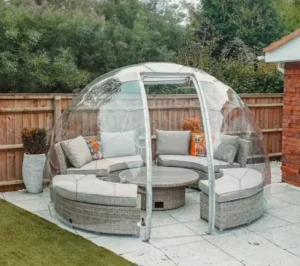
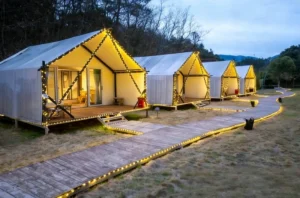
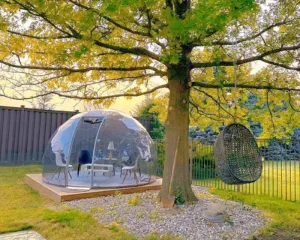
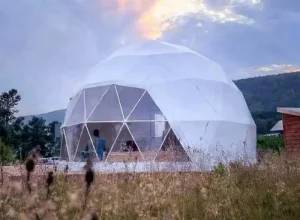
When you’re preparing to purchase geodesic dome tents for your luxury glamping site, the first and most crucial question you’ll face is:What size is best suited for your campsite?
Geodesic dome tents on the market range from 4 meters to over 10 meters in diameter, but in actual glamping projects, the 7-meter diameter is almost the most frequently chosen and least controversial option.
This guide will focus on the 7m geodesic dome tent, combining real-world campsite usage to help you determine:
- Is it suitable for your campsite?
- How to choose the right one without making mistakes?
You can read along and compare it to your own campsite plans.
Why do many glamping sites choose 7-meter dome tents?
The core of glamping boils down to two things: comfortable accommodation + a unique appearance. The size and structure of the tent directly determine the guest experience and affect your pricing and return on investment.
Too small, and it feels cramped; too large, and it wastes space and budget. The 7-meter geodesic dome tent strikes a very “comfortable” balance.
The 7-meter size is a “golden balance point” for campsite operation
A 7-meter diameter dome tent has an internal usable area of approximately 38–39㎡.
You’ll find this space very convenient when setting it up.
It easily accommodates a 1.8m or 2m large bed.
There’s still room for a lounge area, a small table, and luggage storage.
It’s spacious for 2 people, not crowded for 4, and can flexibly accommodate up to 6 people.
Compared to 9-meter or even larger dome tents, the 7-meter size doesn’t require significant changes to your site layout; compared to smaller sizes around 5 meters, it’s clearly more “like a room” and easier to justify a higher nightly price.
Many campsites choose 7 meters for one essential reason: sufficient space without waste.
Geodesic structure: Not just good-looking, but truly stable
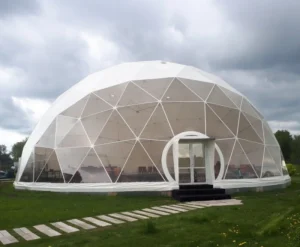
Unlike traditional pole tents, the geodesic dome tent structure is a complete framework composed of numerous triangles. The advantages of this structure become particularly evident in harsh weather conditions:
The force is distributed, resulting in strong wind resistance.
The arched dome prevents snow from accumulating easily.
The continuous fabric covering reduces the risk of leaks.
A reliable 7-meter geodesic dome tent can normally withstand strong winds, heavy rain, and even moderate snowfall.
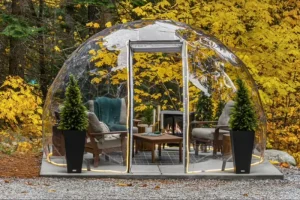
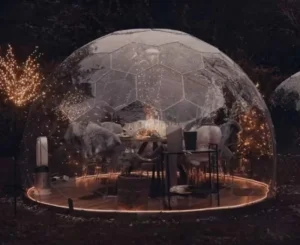
But more realistically, it’s incredibly photogenic. With good lighting during the day and string lights at night, you can easily take “Instagrammable” photos.
Many campsites’ natural exposure is actually boosted by these geodesic dome tents.
For Glamping, it’s flexible and fast enough
7-meter geodesic dome tents are very user-friendly in terms of customization and installation.
Fabric color, transparency ratio, and logo can all be customized to your style.
Forest style, minimalist style, and resort style are all possible.
4-6 people can complete the setup in 1-2 days.
Unlike fixed buildings that require weeks of approval and construction, the location can be flexibly adjusted later according to the campsite plan. This is very important for campsites that are expanding or want to quickly test the market.
Key considerations when purchasing a 7-meter spherical tent
Four Key Considerations When Choosing a 7-Meter Geodesic Dome Tent
The price range for 7-meter geodesic dome tents varies widely, from seemingly “very cheap” to significantly expensive. The real difference lies not in the size itself, but in these key details:
Frame Material: Determines Structural Stability and Lifespan
Currently, 7-meter geodesic dome tents on the market mainly use two types of frame materials: aluminum alloy and steel.
If your campsite is located in a relatively mild climate, an aluminum alloy frame is usually the more hassle-free option. It’s lightweight, rust-resistant, and easier to transport and install. With normal maintenance, its lifespan is generally 6–8 years, which is sufficient for the long-term needs of most glamping campsites.
Steel frames are more suitable for areas with strong winds, frequent snowfall, or coastal environments. They have a stronger load-bearing capacity and a more stable overall structure, with a lifespan of 8–10 years, but the corresponding cost, weight, and installation difficulty will also be higher.
There is no absolute standard for choosing which frame material to use; the key is to consider your campsite environment and usage intensity, rather than simply pursuing “the heavier, the better.”
Fabric Selection: Directly Affects the Guest Experience
The fabric is one of the most direct factors affecting comfort, and there are three main types.
PVC fabric offers stable waterproofing, is easy to clean, and is cost-effective, making it the most widely used type. However, its breathability is average, and ventilation through doors and windows is needed to mitigate stuffiness.
PC (polycarbonate) fabric offers strong transparency and good insulation, making it more suitable for campsites that prioritize scenic views or plan for year-round operation, but the overall cost is relatively higher.
Canvas fabric is breathable, has a natural style, and creates a more camping-like atmosphere, suitable for forest-themed campsites. However, it requires regular maintenance of the waterproof layer, resulting in higher long-term maintenance costs.
Regardless of the fabric chosen, it’s recommended to prioritize thicker versions (e.g., PVC ≥ 0.6mm), and also pay attention to details such as zippers and mosquito nets, as these often affect the actual experience more than the appearance.
Configuration Details: Often Determine Long-Term Convenience
Many problems encountered by campsites during operation are not due to poor tent quality, but rather insufficient consideration of configuration details during the initial planning stage. Too few doors and windows can lead to insufficient ventilation and stuffiness in the summer; the lack of flooring can cause dampness, significantly increasing cleaning and maintenance costs; and the absence of pre-installed power outlets makes adding equipment later troublesome and aesthetically unappealing.
If you plan for long-term use, you should at least consider a double-door or multi-window design, upgraded flooring, whether insulation is needed, and whether the fixing system is suitable for the local terrain. These configurations may seem insignificant, but they directly affect your operational efficiency and guest satisfaction.
After-sales service and customization are crucial for long-term investment value
Spherical tents are not disposable products. A reliable supplier should at least provide a 3-5 year warranty, support the replacement of individual parts, and possess truly customizable capabilities.
If problems arise during peak season, it affects not only the tent itself but also the occupancy rate and reputation of the entire campsite.
Installation and Maintenance of a 7-Meter Geodesic Dome Tent
From a practical perspective, the installation process of a 7-meter geodesic dome tent is relatively straightforward and not a high-difficulty construction project. Under normal weather conditions and with adequate personnel, a team of 4–6 people can complete the entire setup within 1–2 days.
Before installation, the focus is on preparing the site foundation, ensuring the ground is level and free of sharp objects, and marking the center point and fixing positions in advance. Then, the frame assembly and fabric covering are completed sequentially, and the structure is reinforced with ground stakes and guy ropes. Once the main structure is stable, the doors, windows, flooring, and basic interior fittings are installed. The overall process is clear and manageable.
Routine maintenance primarily involves regular inspections. After guests check out, basic cleaning is performed, and zippers, doors, windows, and vents are checked to identify any potential problems. Weekly checks of the ground stakes and guy ropes and other fixing systems can effectively improve the overall safety of the tent in windy weather.
After seasonal changes or prolonged continuous use, it is recommended to perform a more comprehensive maintenance of the tent, including cleaning the exterior fabric, ensuring it is completely dry, and checking the condition of the waterproof layer and frame connections. Timely repair or replacement of parts if minor wear or aging is found can effectively extend the overall service life.
Overall, with proper installation and maintenance, a 7-meter geodesic dome tent can realistically and commonly be used for 5–8 years. For campsite owners, this type of tent offers a relatively balanced and sustainable option in terms of installation difficulty, maintenance costs, and service life.
7-Meter Geodesic Dome Tent Price Reference
Based on the current international market, the price for 7-meter geodesic dome tents mainly depends on the frame material, fabric configuration, and degree of customization. The following is a relatively common price range, all in US dollars (USD):
Basic Model: Approximately USD 1,800 – 3,000 / tent
This category usually uses an aluminum alloy frame with standard PVC fabric. The configuration is relatively basic, making it more suitable for camps that are just starting out, have limited budgets, or are in the testing phase.
Standard Model: Approximately USD 3,000 – 5,000 / tent
This is the most common and popular price range on the market. The configuration and durability are relatively balanced, meeting the long-term needs of most mid-to-high-end glamping camps.
High-End Custom Model: Approximately USD 5,000 – 10,000 / tent
This usually uses higher-specification frames and fabrics, and includes customized configurations such as insulation layers, wooden floors, or terraces. It is more suitable for resort-type projects or camps planning year-round operation.
When evaluating your budget, you also need to consider shipping costs, import taxes, and installation costs, which vary significantly in different countries and regions. If you plan to purchase more than 10 tents at once, you can usually negotiate a bulk discount of around 10%-20% with the supplier, making the overall cost more manageable.
What kind of return can a 7-meter geodesic dome tent bring to your campsite?
Whether a campsite is “profitable” is never determined by a single tent alone, but in actual operation, 7-meter geodesic dome tents have indeed played a significant positive role in many campsite projects.
Many campsites that have upgraded from smaller tents or traditional accommodation units to 7-meter geodesic dome tents often see the most direct change in their pricing potential. Compared to ordinary tents, 7-meter geodesic dome tents offer a greater sense of space and a superior visual experience, making them more readily accepted by guests at a higher nightly price, especially in campsites with good views. This advantage is even more pronounced.
In terms of occupancy rates, the change is often not a “surge,” but rather greater stability. The comfort and distinctive appearance of the dome tent make it more likely to be chosen during the off-season or weekdays, reducing vacancies caused by cramped spaces or a lack of unique experiences. For campsites that rely primarily on weekends and holidays for revenue, this stability itself is very valuable.
Another often overlooked point is that 7-meter geodesic dome tents have strong marketing potential. Their unique appearance, better lighting, and ambiance encourage guests to take photos and share them on social media platforms. While this exposure is difficult to quantify directly in terms of revenue, in the long run, it can reduce customer acquisition costs and become an integral part of the campsite’s marketing strategy.
It’s important to emphasize that the 7-meter geodesic dome tent is not a magic bullet that guarantees profitability. It’s more like an amplifier: if your campsite location is well-chosen, your positioning is clear, and your supporting services are adequate, it can help amplify your advantages; but if your basic operations are lacking, it’s unlikely to change the outcome on its own.
From an investment perspective, the value of the 7-meter geodesic dome tent lies in finding a relative balance between cost, experience, and market acceptance. This is why it has been repeatedly validated and adopted by numerous glamping projects.
Why choose Gaxdome’s 7m Geodesic Dome Tent?
In actual projects, many campsite owners, after comparing different brands, ultimately chose Gaxdome’s 7-meter geodesic dome tent, and the reasons are not complicated.
Gaxdome’s 7m dome performs well in several key areas:
- The frame structure has been tested in wind and snow environments, ensuring high stability.
- The fabric selection is geared towards long-term operation, not one-off projects.
- It supports deep customization from appearance to interior configuration.
- It demonstrates a mature understanding of the usage scenarios for glamping campsites, rather than simply selling a product.
If you are looking for a 7-meter geodesic dome tent that can be used stably for a long time, while also balancing aesthetics and experience, Gaxdome is a choice worth serious consideration.
Conclusion
For glamping campsites, the 7-meter geodesic dome tent is not just a “common size.”
It’s more like a reliable choice that has been proven through extensive practice.
As long as you choose the right frame, fabric, and configuration based on your campsite environment, and work with a reliable supplier and follow proper maintenance procedures,
it can become one of the most stable and profitable accommodation units in your campsite.
If you’re planning or upgrading a campsite, a 7-meter geodesic dome tent is definitely worth serious consideration.