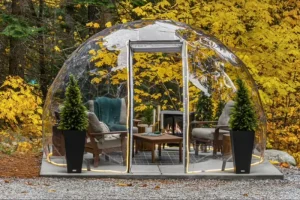
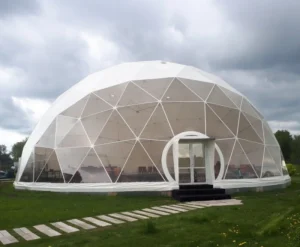
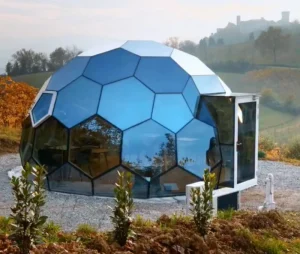
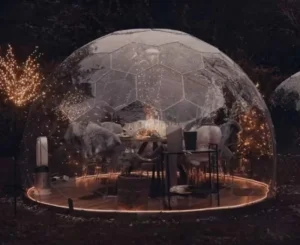
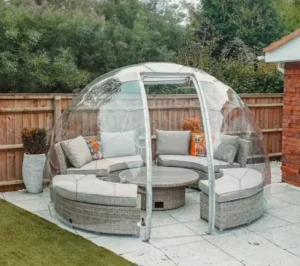
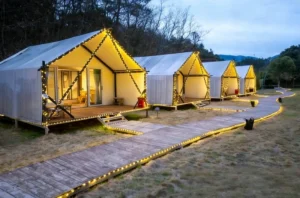
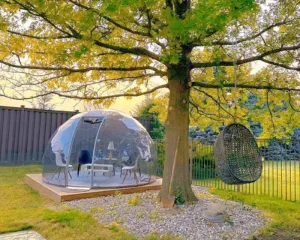
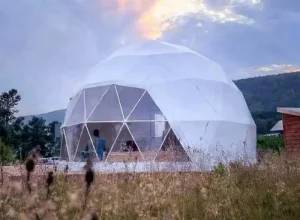
The overall cost of purchasing a glass dome house typically ranges from $4,000 to $20,000, depending on the dome size, material choices, degree of customization, shipping method, and installation conditions.
In other words, buying a glass dome house is not a simple product purchase, but a complete project investment. Many buyers who only focus on the “kit price” ultimately find that the actual budget is often 30%-50% higher than expected.
Introduction
In recent years, glass dome houses have rapidly gained popularity worldwide, especially in glamping sites, eco-resorts, boutique guesthouses, and private gardens.
However, during the consultation process, many buyers encounter the same problem:The initial quote seems reasonable, but when the project is actually implemented, the overall cost significantly exceeds expectations.
The reason is not complicated—buying a glass dome house involves multiple cost levels, not just “buying a dome.” If these costs are not included in the budget beforehand, overspending is almost inevitable.
This article will systematically break down the entire cost structure from the factory kit to final use, based on practical project experience, helping you gain a clear and controllable understanding of “how much it really costs to buy a glass dome house” before making a decision.
Glass Dome House Kit Price
When you inquire about the price of a glass dome house from a manufacturer, the first quote you receive is usually the price of a standard glass dome house kit.
This price can be understood as the basic cost of a dome from “zero” to “ready to be assembled,” and is the starting point for all budget calculations, but it is not equivalent to the final project investment.
Many people find the price differences difficult to understand when they first learn about glass domes: the appearance looks similar, the size only differs by one or two meters, but the price can differ by several thousand dollars. In reality, the difference often lies in the size, frame structure, and covering materials—these key configurations.
Basic Kit Prices for Different Dome Sizes
Size is the most intuitive and easily perceived factor affecting the price of a glass dome kit. Generally, the larger the dome diameter, the more structural components, covering materials, and connectors are required, and the overall cost naturally increases accordingly. The price ranges for common sizes (excluding transportation and installation) are approximately as follows:
Diameter 5–6 meters (16–20 feet)
These domes are mostly used in private gardens, small leisure spaces, or experiential projects. The overall structure is relatively compact, and the price is usually between $3,000 and $4,500, making them an entry-level option.
Diameter 7–8 meters (23–26 feet)
This is a very frequently used size, offering a good balance between space utilization and cost control. It is suitable for both commercial and long-term use, with a price range of approximately $4,500–$7,000.
Diameter 9–10 meters (30–33 feet)
The sense of space is significantly improved, making it more suitable for accommodation, reception, or high-end display purposes. It requires higher structural strength and materials, and the price is generally between $7,000 and $11,000.
Custom or extra-large domes
When the size increases further, or involves non-standard designs, the overall price usually starts at $12,000 and will increase further depending on the structural complexity.
These basic kit prices usually include the main dome frame, standard transparent or translucent covering panels, connectors, and basic accessories, which can meet the basic construction needs of a dome.
Frame structure: its impact on cost and service life
If size determines “how big” the dome is, then the frame structure determines how long it will last and what environmental conditions it can withstand.
Currently, common frame options for glass dome houses mainly focus on the following two types:
Galvanized steel structure
This is the most widely used option. It has high overall strength and good stability, performing excellently in wind and snow resistance, making it more suitable for long-term use or commercial projects. For users who want to reduce future maintenance and pursue safety and reliability, this is a relatively safe choice.
Aluminum alloy structure
Compared with steel structures, it is lighter and has better corrosion resistance, making it particularly advantageous in coastal areas or environments with high humidity. However, the material and processing costs are higher, usually increasing the overall kit price by approximately 15%–30%. In real-world projects, many people find that the choice of frame structure often directly impacts subsequent maintenance costs and service life, not just the initial purchase price.
Covering materials determine the user experience and price differences.
Although often referred to as “glass dome houses,” the covering material is not necessarily real glass in actual use.
The differences in appearance, durability, and cost of different materials will be clearly reflected in the final quotation.
PC (polycarbonate) panels
This is currently the most widely used material, striking a good balance between light transmission, impact resistance, and cost-effectiveness. It ensures a sense of openness in the space and is suitable for long-term outdoor use, making it the preferred choice for most projects.
Tempered glass (partial or complete)
It offers superior visual effects and texture, suitable for projects with high requirements for space quality and display effect. However, due to its greater weight, it requires more robust structures and transportation, and the overall cost usually increases by an additional $2,000–$6,000.
Transparent PVC membrane
It has a lower initial investment and is mostly used for seasonal or short-term applications. However, its service life is relatively limited, making it more suitable as a transitional solution.
Custom Configuration of Glass Dome Structures
In real-world projects, it’s rare for anyone to purchase a glass dome structure exactly as a “standard model.”
When you start considering actual user experience, operational needs, or long-term plans, custom configurations often become the starting point for a significant increase in budget.
These configurations don’t seem extravagant individually, but when added together, they can easily change the overall cost.
Doors, Windows, and Entrance Systems
The entrance design is often the first part to be adjusted.
The basic kit usually includes a standard single door, which meets basic entry and exit needs. However, in actual use, many people find that the standard door has limitations in terms of natural light, views, or ease of access.
Therefore, many projects choose to upgrade to panoramic glass doors or sliding doors, which generally cost between $300 and $1,200, significantly improving the sense of spaciousness and overall quality.
If commercial operation or safety regulations are involved, additional entrances or emergency exits may be required. These configurations are usually charged separately per set, further increasing the budget.
Insulation Systems for Four-Season Use
If the glass dome is only used seasonally, insulation is not a necessity;
However, if you plan to use it year-round or for long-term operation, an insulation system is almost an unavoidable configuration.
Common solutions include:
- Double-layer covering system: Improves insulation performance by creating an air gap, costing approximately $600–$2,000.
- Internal insulation layer: Further reduces heat loss, costing $400–$1,200.
- Anti-condensation treatment: Effectively improves humidity and condensation problems, costing approximately $200–$600.
These configurations won’t make the dome “look more luxurious,” but they significantly improve comfort, usability, and user experience, which is why many projects are willing to invest in them.
Internal Basic Preparation Costs
Even just to achieve “basic usability,” the preparation work inside the dome cannot be ignored.
The flooring is often the first step. Depending on the material, the cost of the flooring system is approximately $8–$15 per square foot, directly affecting overall comfort and durability. Next are the most basic functional configurations, such as the lighting system, which usually costs between $100 and $300;
If more comprehensive usage needs are involved, pre-installation of electrical wiring and interfaces is also required, costing approximately $300–$800.
In terms of air circulation, many projects add ventilation equipment or skylights, which generally cost $150–$500, but significantly improve the indoor experience.
Transportation and Logistics
When purchasing a glass dome house, transportation is often the most underestimated and most likely to cause disappointment.
Many people only focus on the price of the product itself, and only realize that transportation costs account for a considerable proportion when calculating the total cost.
Domestic or Regional Transportation
For short-distance delivery, the cost is relatively controllable, usually between $300 and $800.
However, once cross-regional transportation is involved, truck transportation costs often rise to $800–$2,000, depending on the distance and loading method.
International Shipping Costs
For cross-border procurement projects, the difference in transportation costs is even more significant:
Less than Container Load (LCL) shipping: approximately $500–$1,500, suitable for small-batch purchases
Full Container Load (20-foot/40-foot) shipping: usually $2,000–$5,000
In addition, different regions also need to consider tariffs, customs clearance, and related handling fees. Overall, transportation costs often account for 15%–30% of the overall budget, making advance estimation particularly important.
Installation and Site Construction Costs
When buying a glass dome house, don’t overlook the costs of installation and site preparation. While glass dome houses may appear structurally simple, the actual installation and site construction require significant investment.
Choice of Installation Method
- Self-installation: This can significantly reduce costs, but requires high levels of construction skills, tools, and time, and is more suitable for experienced teams.
- Professional Installation Team: The cost per unit is usually between $500 and $3,000. For commercial projects or long-term use scenarios, this method is safer and more convenient.
Different foundation types have a direct impact on costs:
- Concrete foundation: Approximately $6–12 per square foot
- Wooden platform: Approximately $8–15 per square foot
- Steel structure platform: Mid-range in price, but usually requires customization
In addition, hidden costs such as site leveling and equipment rental often add $500–2,000, which should not be overlooked in the budget.
Long-Term Use and Maintenance Costs
Buying a glass dome house does not mean the project ends after delivery.
Unlike ordinary tents or membrane structures, glass domes are closer to a long-term building form, and subsequent costs are more focused on maintenance and upkeep, rather than frequent replacement.
Service Life of the Covering System
In glass domes, the covering system usually consists of tempered glass or high-strength transparent panels. As long as the selection is reasonable and the installation is standardized, its service life is generally long.
- Tempered Glass Panels: Under normal use and maintenance conditions, there is no fixed replacement cycle. As long as there is no external damage, the glass itself can be used for a long time; the focus is more on the sealing condition and structural connections.
- Transparent PC Panels: If some projects use high-grade PC panels as transparent coverings, their typical service life is usually 10–15 years, mainly affected by ultraviolet rays, environmental temperature differences, and cleaning methods.
Compared with soft covering materials, glass domes have significantly lower long-term costs in terms of “material replacement,” closer to a one-time investment and long-term use model.
Daily Maintenance and Upkeep Costs
The daily maintenance of a glass dome focuses not on the structure itself, but on the following aspects:
- Cleaning of glass or transparent panels: To maintain light transmission and visual effects, regular cleaning is usually required, especially in dusty, rainy, snowy, or coastal environments.
- Sealing system inspection: Sealing strips, sealants, and connection points are key maintenance areas, requiring regular inspection for aging or loosening to prevent water leakage or thermal bridging problems.
- Hardware connection maintenance: This includes inspection and tightening of bolts, connectors, and fasteners to ensure the long-term stability of the overall structure.
In most projects, annual maintenance costs are usually controlled at $200–600, mainly depending on the dome size, usage environment, and cleaning frequency.
Overall Budget Reference for Different Application Scenarios
Different usage scenarios have significantly different priorities in terms of configuration and investment.
Campsites and Eco-Resorts
A complete set typically costs between $6,000 and $12,000. Bulk purchasing can further reduce the cost per unit.
Private Gardens or Vacation Homes
Entry-level configurations cost approximately $4,000–$6,000;
For better comfort and aesthetics, high-end configurations usually cost $8,000 or more.
Commercial and Hotel Applications
These require higher standards for structural safety, appearance quality, and long-term stability. Typical overall budgets range from $10,000 to $20,000 or even higher.
How to Make the Best Glass Dome Choice within Your Budget?
Truly experienced buyers in glass dome projects don’t simply pursue the lowest price. They understand which investments directly affect the safety and lifespan of the glass dome, and which configurations can be completed in stages based on actual operational needs.
Making reasonable trade-offs within a limited budget is often more important than simply lowering the purchase price.
First, prioritize allocating the budget to the structural safety and core materials of the glass dome. The strength of the frame, connection nodes, and the quality of the transparent covering material directly determine the dome’s stability in wind, snow, temperature changes, and long-term use. Compromising on these aspects is difficult to compensate for with simple upgrades later.
Secondly, consciously control decorative and non-functional configurations in the initial stages of the project. While aesthetics are important for glass domes, not all visual upgrades need to be completed in the first phase. Leaving room for future improvements allows for later optimization.
At the same time, choosing a glass dome solution that supports future upgrades is crucial. For example, expandable insulation systems and add-on ventilation or shading configurations allow the project to be gradually improved as usage needs change, rather than requiring a high upfront investment.
Finally, collaborating with manufacturers who have experience in glass dome projects and offer clear and transparent pricing structures can avoid many hidden costs and misjudgments. Considering long-term use and maintenance issues from the design stage makes budget control more predictable. In this way, it becomes easier to obtain a structurally reliable, stable, and long-lasting glass dome space within a controlled budget, rather than just a dome that “looks cheap.”
Summary
Buying a glass dome house is not simply about comparing single quotes; it requires considering the costs of the kit, customized configurations, transportation, installation, and long-term maintenance on the same timeline. When these costs are clearly broken down in advance, the overall budget becomes more controllable, and it’s easier to make choices that meet actual needs.
With proper planning, a glass dome house not only offers excellent visual appeal but is also a suitable space solution for long-term use. Making the right purchase often comes from understanding the cost structure, not just focusing on the price itself.
As a dome tent manufacturer ,Gaxdome provides customized glass dome services for campsites, resorts, and commercial projects. From structural design and material selection to production and manufacturing, everything revolves around safety, durability, and practical use scenarios, helping clients achieve stable and feasible project implementation within their budget.
If you are evaluating the overall budget for a glass dome house or would like to understand the actual cost differences of different sizes, structures, and configuration options, please contact us. By clarifying your needs and usage scenarios, we can provide you with clearer and more actionable configuration suggestions and price references.