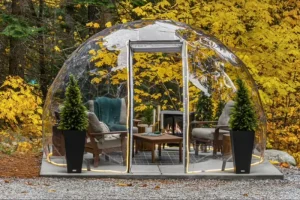
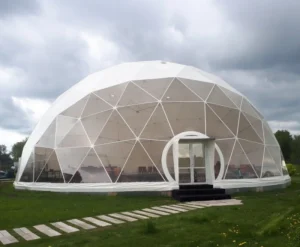
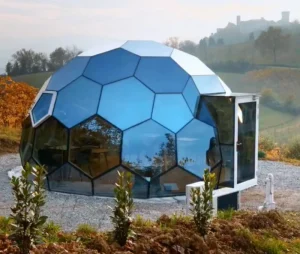
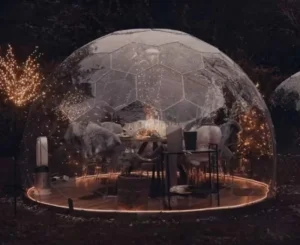
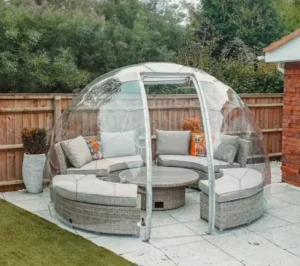
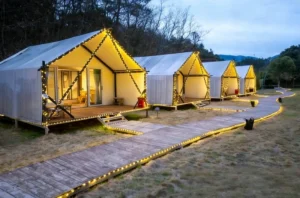
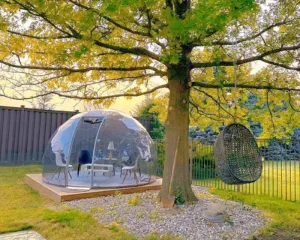
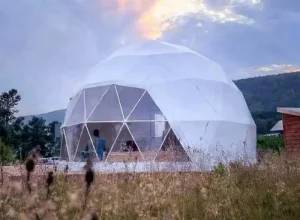
Geodesic Dome Homes can be used for long-term living, but only if you choose a “residential-grade dome,” not a lightweight tent-like structure designed for short-term experiences.
With adequate structural strength, insulation systems, utilities, and compliance with regulations, a geodesic dome home can serve as a long-term living space for 5–20 years or more; if designed only for vacations or experiences, it is more suitable for short-term or seasonal use.
This is why some people live comfortably in domes, while others quickly give up. The problem is never whether a dome “can be lived in,” but rather whether the specific dome you choose is designed for long-term living.
What is a geodesic dome home?
If you’re not yet familiar with geodesic dome homes, you might find very polarized reviews online.
Some say they are quiet, energy-efficient, and allow for living in harmony with nature; others say they are stuffy, hot, and impractical, not at all like a real house. The fundamental problem is that people are often discussing different types of products.
What is a geodesic dome home? From a professional perspective, domes on the market can be broadly divided into three categories:
Lightweight dome tents
These often use PVC or canvas exteriors, are quick to assemble, and low-cost, commonly found in glamping, event accommodation, or short-term experiences. The core value of these domes is the “experience,” not the stability for long-term living.
Insulated or semi-permanent domes
These products have added insulation layers and a more stable structure, suitable for long-term rental or vacation use, but are usually still designed for “long-term use” rather than “long-term living.”
True Geodesic Dome Home
These typically use steel structures or high-strength aluminum alloy frames, and the enclosure system is closer to building-grade standards, allowing for full integration of water, electricity, sanitation, and ventilation systems. From a living perspective, it’s more like a house with an unconventional shape.
Can geodesic dome homes be used for long-term living?
Regarding the question of whether they can be used for long-term living, what people really want to know is not “can they,” but “is it worthwhile.”
From a practical perspective, as long as the configuration is properly planned, geodesic dome homes do not have any structural obstacles to long-term living. Because of its structural design, which determines its overall stability, it actually has advantages over some lightweight traditional buildings in strong winds and heavy snow.
However, the reality is also clear: it’s not simply “a dome with some furniture that you can live in for many years.”
Domes truly suitable for long-term living often have features that are not immediately apparent, such as:
- Whether the waterproofing at the joints considers condensation issues
- Whether the insulation layer is suitable for the local temperature differences between winter and summer
- Whether the ventilation system supports long-term enclosed use
These details determine whether you will “live” or “endure” after moving in.
Under what conditions is a geodesic dome home suitable for long-term living?
If you are seriously considering a dome as your home and want to live in it long-term, not just for a novel experience, then you need to pay attention to the following points when choosing to buy a geodesic dome home:
First, the positioning of the structure itself
A dome for long-term living must be a permanent or semi-permanent structure, not a lightweight frame that can be easily disassembled. A stable frame system is the foundation of all comfort.
Secondly, a complete insulation and waterproofing design
It’s not simply “thickening” the materials, but a systematic plan for year-round use. A true residential-grade dome will consider thermal bridging, moisture, and heat circulation, not just coping with one season.
Thirdly, whether the living systems are complete
- Can you shower, cook, and work normally inside?
- Is there a stable power supply and drainage system?
These determine whether the dome is a “dwelling” or a “campsite.”
Finally, regulations and land use attributes
In some areas, domes can be used as ADUs, vacation homes, or long-term living units; in other places, they may be considered temporary structures. This issue is often more critical than the product itself.
When all these conditions are met, the long-term living experience in a Geodesic Dome Home is often more mature than imagined.
Under what circumstances is a Geodesic Dome Home not suitable for long-term living?
When discussing whether a Geodesic Dome Home is suitable for long-term living, a frequently overlooked premise is that not all domes are designed for “living in for a long time.”
If this is ignored, many problems will only become apparent after moving in.
Lightweight canvas or experiential domes are not designed for long-term living
Some people, when considering long-term living, are actually looking at lightweight domes primarily intended for glamping or short-term accommodation. The focus of these types of domes is often on construction efficiency and visual experience, rather than comfort for continuous use over many years.
In actual living, you will gradually notice that temperature changes are more direct and external sounds are clearer, especially in windy or rainy environments. These details will constantly remind you that it is more suitable for short stays than for daily life.
If you are accustomed to the spatial logic of traditional houses, a dome may not be user-friendly.
The space in a Geodesic Dome Home is entirely open, emphasizing spatial continuity rather than room division. If your lifestyle heavily relies on clear functional divisions, such as needing distinct bedrooms, workspaces, and storage spaces, then this open structure may leave you constantly in a state of “needing adjustment” during long-term use.
This discomfort doesn’t come from usage techniques, but from a fundamental difference between spatial logic and living habits.
If you rely heavily on standardized furniture and efficient storage, you need to choose carefully.
In a dome space, many ready-made furniture pieces cannot fully utilize their original efficiency. The curved walls will change the way furniture is arranged and will also affect the overall storage plan. If you want your living space to be highly modular and require almost no customization, then living in a dome for a long time may bring continuous minor inconveniences, and these details will gradually affect the overall living experience over time.
Multi-member families have higher demands for privacy and sound insulation.
For single people or couples, the open space of a dome is often an advantage; but when the number of family members increases, especially when different schedules or independent spaces are needed, the challenges of a dome become apparent.
Although improvements can be made through design, compared to residential forms that inherently emphasize division, domes often require more effort to maintain long-term life balance.
If your acceptance of architectural forms is more traditional, psychological adaptation is equally important.
Some discomfort in living experience doesn’t directly come from function, but from psychological expectations. If you prefer to live in a space that “looks like a traditional house,” then even if a Geodesic Dome Home has no obvious problems in use, it may still create a subtle sense of alienation in the long run.
This feeling won’t appear immediately, but will often gradually amplify over time.
Advantages and limitations of long-term living in a Geodesic Dome Home
After living in a dome for a while, you will gradually realize that it is not “strange,” but “different.” Its advantages are straightforward:
- Even stress distribution, strong wind and snow resistance;
- Good overall spatial integrity, providing a more open visual and psychological experience;
- With reasonable design, energy consumption performance often exceeds expectations.
However, it also has real limitations.
- A circular space means you need to rethink furniture and storage methods;
- Sound insulation and privacy need to be addressed through design;
- And the uncertainty of regulations and approvals may increase initial communication costs.
These are not necessarily disadvantages, but rather criteria for determining whether it’s suitable for you.
Long-term living vs. short-term use: A comparison table for quick assessment
In actual consultations, many people repeatedly ask the question: “This Geodesic Dome looks promising, but can it really be lived in long-term?”
The focus for long-term living and short-term use is completely different, and this difference is often determined by the structure and configuration.
The following comparison table can help you understand the core differences between the two types of domes in just a few minutes:
Comparison Dimension | Long-term Living Geodesic Dome | Short-term / Experiential Dome |
Service Life | 5–20 years or longer | 1–5 years |
Structural System | Permanent or semi-permanent structure | Lightweight structure |
Insulation Performance | Comprehensive insulation design for all-season use | Basic or seasonal insulation |
Utilities and Bathroom | Complete living system configuration | Simplified configuration or no facilities |
Suitable for | Self-occupancy, long-term living | Vacation, camping, experiential projects |
Living Experience | Closer to conventional housing | Clearly geared towards temporary living |
If you plan to live in the same space for many years, experience all the seasons, and consider this your core living space, then prioritizing a long-term living Geodesic Dome is a safer choice. It may have higher initial costs, but it provides a more stable living experience and lower long-term adaptation costs.
If your goal is camp operation, vacation rentals, or temporary use, then a short-term or experiential dome is often more flexible and easier to implement quickly. In this scenario, peak comfort is more important than sustainability.
If you are currently unsure about the service life, you can use “whether it supports future upgrades” as a key criterion. Some structures allow for a gradual transition from experiential to long-term use, while others have design limitations that restrict their use.
Is a Geodesic Dome Home or another modular home more suitable for you?
At this point, the question is no longer “Is a geodesic dome good or bad?”, but rather “Is it right for you?”
If you yearn for nature, enjoy independent space, are open to unconventional layouts, and have relatively flexible land use conditions, then a Geodesic Dome Home is likely to be a satisfying long-term option.
However, if you prioritize storage efficiency, spatial order, and functional zoning for your family, or if your area has many restrictions on building forms, then modular wooden houses, container homes, or prefabricated houses might be a more hassle-free option.
Several practical issues you must confirm before deciding on long-term residency
Before truly deciding to use a geodesic dome home as your long-term residence, several practical issues must be clarified. Simply asking the questions isn’t enough; the key is understanding the underlying logic behind each question, as these directly determine whether the dome is suitable for long-term living.
- Is the dome permitted as a long-term residential building in your area?
- Is the design suitable for your climate?
- Does the lifespan meet your plans?
- Are the long-term maintenance costs manageable?
- Does it support future upgrades or expansions?
If most of your answers are “meets long-term use requirements, legally habitable, comfortable, and maintainable,” then this Geodesic Dome Home is basically suitable for long-term living.
If the answers are mostly “restricted, uncontrollable, or only suitable for short-term use,” then even if it has a unique appearance, it’s more suitable for vacations, short-term experiences, or seasonal use, rather than daily life.
This confirmation step is often more important than focusing on “how beautiful it looks,” and it can help you avoid problems after moving in.
Summary
A geodesic dome home is neither a gimmick nor a one-size-fits-all solution. It’s a re-evaluation of space, living style, and the relationship with the environment.
Under the right structural, configuration, and regulatory conditions, it can become a stable, comfortable, and highly integrated long-term living space;
However, under unsuitable conditions, it is indeed more suitable for short stays.
What truly matters is never “whether it’s a dome,” but rather—have you chosen the right solution for your long-term living needs?