Introduction
Agriculture is facing unprecedented challenges in the context of climate change, resource constraints and growing demand for food. This has led to a search for more innovative ways of growing crops, with the agrodome gaining attention as a cutting-edge greenhouse structure.
Not only does it provide an ideal environment for growing crops, but it is also a modern agricultural solution that is both sustainable and scalable for a variety of scenarios, including growers, educational institutions, and research institutes.
What is an Agricultural Dome?
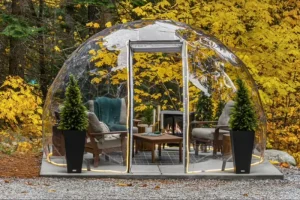
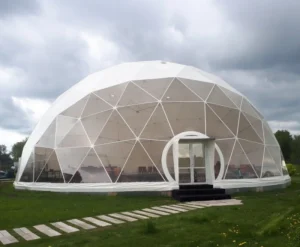
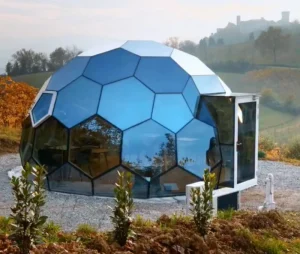
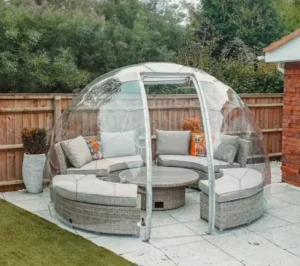
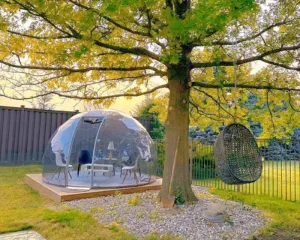
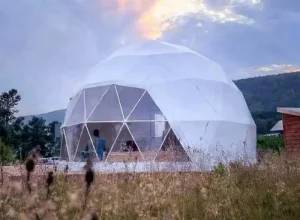
An agrodome is a modern agricultural growing space based on the geodesic dome structural design, proposed and developed by architect Buckminster Fuller. It is usually hemispherical in shape and consists of multiple interconnected triangular or hexagonal frames that form a self-supporting, solid and lightweight structure.
With superior structural strength, energy efficiency, light efficiency and wind and snow resistance compared to traditional greenhouses, agrodomes maximize the use of sunlight while providing good insulation and ventilation, making them ideally suited for sustainable agricultural production in variable climates or remote areas.
What are the benefits of geodesic domes in agriculture?
Geodesic domes bring a number of significant advantages to agriculture, making them a strong alternative to traditional greenhouses and open-air growing:
1.Excellent energy efficiency
The unique shape and structure of the dome helps to minimize heat loss and keep the dome warmer in the winter and cooler in the summer. This means significantly lower energy consumption compared to traditional greenhouses, resulting in savings in operating costs.
2.Maximizing sunlight
The curved surface of the geodesic dome allows sunlight to reach the plants in a more uniform manner, reducing shaded areas. This promotes healthier plant growth and higher crop yields.
3.Resistant to severe weather
Whether it’s strong winds, heavy snow or hail, the domes’ rugged construction provides superior protection. They are able to withstand extreme weather conditions, ensuring that crops can grow safely throughout the year.
4.Water conservation
Inside the domes, water can be efficiently recycled through closed systems such as hydroponics or aquaponics. This significantly reduces reliance on traditional irrigation, which is particularly important in areas where water is scarce.
5.Extended growing season
Because the dome effectively regulates internal temperatures, farmers can grow crops for a longer period of time, even during seasons that are traditionally unsuitable for farming, thereby increasing annual yields.
6.Reduced pests and diseases
The enclosed environment of the dome helps to isolate external pests and diseases, thereby reducing the need for pesticides and insecticides and promoting healthier, more sustainable growing practices.

Other Applications of Agricultural Domes
Due to its high structural strength and controllable internal environment, agricultural domes have been widely used in a variety of agricultural and education-related fields, not only limited to traditional vegetable and fruit cultivation, but also play an important role in the following scenarios:
1. Seedling Domes
Agricultural domes provide a stable microclimate for seed germination and seedling growth, avoiding the impact of extreme weather on seedlings and improving the consistency of seedling emergence and growth.
Seedling Domes provide a stable microclimate for seed germination and seedling growth, avoiding the effects of extreme weather on seedlings and improving seedling emergence and growth consistency. Temperature, humidity and light can be regulated inside the dome, making it ideal for the early cultivation of high value-added crops.
Nursery farms in British Columbia, Canada, use fully enclosed geodesic domes for alpine crop nurseries, maintaining a constant temperature of 20°C or more, even in winter.
2. Teaching Farms and Agricultural Education (Educational Farm Domes)
Many schools and agricultural universities choose domes as teaching practice spaces for students to experience modern agricultural technology and sustainable growing systems. Dome transparency, a strong sense of space, but also conducive to the popularization of science and display activities.
The Department of Agriculture of the University of California, Davis (UC Davis) has constructed a number of small agricultural domes on campus, which are used for the teaching of intelligent irrigation systems, vertical agriculture and hydroponics experimental courses.
3. Agricultural Research Facilities (Research Domes)
Agricultural research institutions use domes as closed experimental environments for crop variety testing, pest and disease simulation experiments, and climate adaptation studies. Its closed and highly controlled, for scientific research provides an excellent “micro-ecological simulation chamber”.
Norwegian Agricultural Research Institute in Oslo, Norway, the use of the dome to simulate the polar day and night conditions of plant photosynthesis changes, to promote crop cultivation research in high-latitude areas.
4. Livestock Domes
Through the optimization of ventilation and thermal insulation design, agricultural domes can also be used for the protection of small livestock (such as chickens, rabbits and sheep). Compared with traditional barns, domes provide more natural light and better ventilation, reducing animal stress and improving the quality of the growing environment.
In Kenya, some farmers have used simple dome structures to raise laying hens and goats, effectively reducing heat stress and improving egg production.
5. Aquaculture Domes
Agricultural domes can also be used to build closed aquaculture systems to provide a stable and controlled growing environment for aquatic organisms such as fish, shrimp and shellfish. Compared with traditional open ponds or open farms, domes have the following advantages
- More precise temperature control: in winter or cold areas, domes can maintain constant water temperature through passive solar heating and auxiliary heating systems, reducing heat loss.
- Disease and pollution avoidance: The enclosed environment helps to isolate external pathogens and sources of pollution, improving aquatic health rates.
- Continuous production throughout the year: Independent of seasonal and climatic influences, continuous aquaculture can be realized throughout the year to improve economic efficiency.
- Easy integration of Recirculating Aquatic System (RAS): The interior space of the dome can be integrated with modern recirculating aquatic systems to realize a sustainable aquaculture model with low water consumption and high density.
At Lacombe Composite High School in Alberta, Canada, the school constructed a 10-meter-diameter Growing Dome geodesic greenhouse for an aquaponics system, where farmed tilapia coexist with hydroponically grown vegetables to create a sustainable closed water cycle. The project not only serves the purpose of year-round aquaculture and education, but is also supported by local agricultural and environmental organizations.
Overall, the agricultural dome is not only an important vehicle for future smart agriculture and sustainable development, but is also becoming an innovative platform for education, scientific research and ecological farming. Its flexible spatial form and stable environmental control capability have enabled it to expand its application boundaries in global agricultural innovation practices.
Geodesic Dome Kits in Agriculture
For ease of erection and use, many manufacturers have introduced geodesic dome kits specifically designed for agriculture. Common components include:
Galvanized steel or aluminum alloy frame with good corrosion resistance
- UV resistant PVC or polycarbonate tarp cover
- Optional features such as skylight at the top, ventilation system, insulation, etc.
- Solar energy system, rainwater harvesting, internal planting racks can be added as required
These kits are generally quick to set up in a matter of days, and some models support dismantling and relocating, making them ideal for agricultural projects that require flexible space management.
Among many manufacturers, Gaxdome, a brand of WZH Group specializing in space structure research and development, is particularly outstanding in the field of agricultural dome kits due to its rich experience in design and high-quality production capacity.
The geodesic dome kits launched by Gaxdome not only ensure long-term stability of the structure, but also optimize the stability of the dome, by combining a durable aluminum alloy or galvanized steel frame with a high-quality transparent or semi-transparent tarpaulin material. long-term stability, but also optimizes the light and thermal insulation performance of the dome.
In addition, Gaxdome also supports personalized customization by adding functional modules such as intelligent ventilation, solar energy system, LED lighting and internal planting racks according to the user’s planting needs, which comprehensively improves the efficiency of agricultural planting and environmental control.
Its modular design greatly simplifies the construction process, and it has been widely used in modern farms, educational parks and ecological greenhouses in many countries and regions. If you are looking for an agricultural dome solution that is functional, aesthetically pleasing and sustainable, Gaxdome is the right choice.
Summarize
The Agricultural Dome is an outstanding result of the fusion of architecture and agricultural technology. It provides an energy-efficient, stable, and controlled growing environment for a wide range of urban and rural agricultural scenarios.
Whether you’re a commercial grower, educator, or sustainable living enthusiast, investing in a high-quality agri-dome promises to give your farming program a major boost.
If you are considering purchasing a dome structure for your farm or plan to do so, it is recommended that you choose a professional manufacturer with the experience to provide customization services and tailor the most appropriate configuration for your local climate and crop needs.