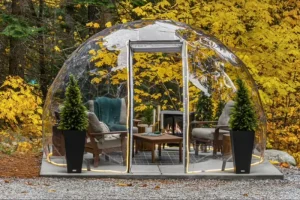
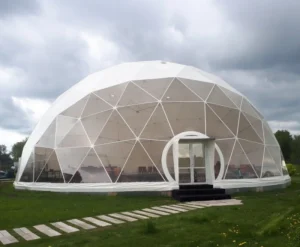
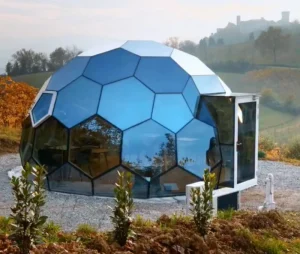
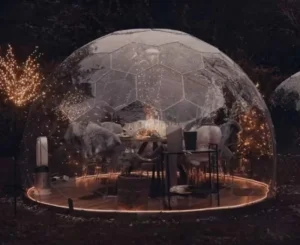
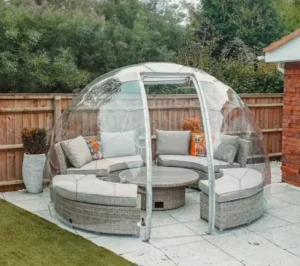
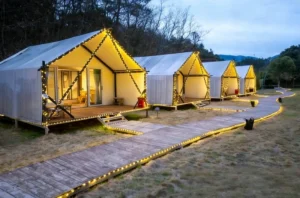
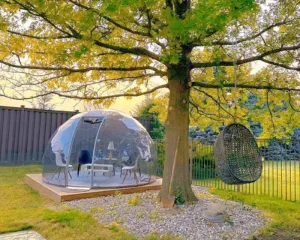
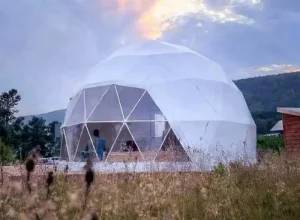
A medium-sized triangular glass dome tent project with a diameter of 6m to 8m typically costs between $30,000 and $70,000 USD. This price is significantly higher than traditional PVC fabric tents because it is a complex engineering project, not simply a piece of camping equipment.
The total cost is mainly composed of six key elements: structural frame cost, foundation engineering costs, transportation and logistics costs, professional installation costs, interior decoration and supporting facilities, and optional upgrade configurations. Focusing solely on the ex-factory price of the structure is far from sufficient, as subsequent logistics and installation costs can significantly increase the final project cost.
Introduction
In recent years, Triangle Glass Dome Tents have rapidly gained popularity in high-end camping, scenic area facilities, and commercial displays. With their highly distinctive appearance and immersive natural experience, they have become a popular choice for glamping projects and boutique hotels.
Unlike traditional tents, the triangular glass dome is closer to a lightweight semi-permanent building than a temporary structure. It has significant advantages in terms of lighting, spatial transparency, and structural stability, which is one of the reasons for the wide price range.
Many people find that when inquiring about prices, the quotes for the same Triangle Glass Dome Tent vary greatly across different projects. This is because it is not a standardized product, and the ex-factory price (EXW) of the structure is only a part of the overall cost. To truly evaluate the price, it is necessary to start from the complete cost breakdown, not just a single quote.

Core Elements of Triangle Glass Dome Tent Cost
In this article, “Triangle Glass Dome Tent” refers to a geodesic or geometric dome structure covered with fully transparent or translucent glass (or polycarbonate PC panels). These products are commonly found in high-end campsites, scenic area facilities, and boutique accommodation projects, and are essentially closer to a lightweight semi-permanent building than a traditional tent.
It is precisely because of this “between tent and building” attribute that its price often confuses investors who are encountering it for the first time. The cost of a triangular glass dome is not concentrated in a single point, but is a combination of multiple aspects including structure, materials, construction, and supporting facilities.
Therefore, the most effective way to truly understand its price logic is not to compare a few simple quotes, but to break down the entire project. Below, we will start with six key cost modules and explain where each part of the cost comes from and why it is difficult to reduce.
1. Structural Frame Cost
The structural frame is the “skeleton” of the entire triangular glass dome project and is the largest component of the budget, usually accounting for approximately [percentage] of the total cost. 40%–55%. It not only determines the size and appearance of the dome, but also directly affects the overall strength, service life, and future maintenance costs.
Impact of Size and Diameter
In a geodesic glass dome, the diameter is the most intuitive and crucial factor affecting the price. The larger the dome, the faster the required frame length, number of nodes, and number of panels increase, so the cost does not increase linearly.
For example, an 8-meter diameter dome often requires two to three times the materials and structural complexity of a 4-meter dome. This is why the price difference for large domes is significantly amplified.
Generally, the **ex-factory price (EXW)** of a medium-sized geodesic glass dome with a diameter of 6–8 meters is usually in the range of USD 15,000–30,000.
Differences in Material Selection
Frame Material
Common choices include high-strength aluminum alloy and high-quality galvanized steel. Aluminum alloy is lighter, has better corrosion resistance, and is more suitable for long-term outdoor use, but the cost is relatively higher.
Panel Material:Tempered glass offers the best light transmission and visual effect, creating a strong sense of space, but transportation and installation are more difficult.
In addition, the number of doors and windows, the opening method, and whether custom or patented connection nodes are used will also be reflected in the final structural quotation.
2. Foundation Engineering Costs
No matter how precise the dome structure is, it must be built on a stable and level foundation. Foundation engineering costs usually account for 10%–15% of the total cost, but they directly relate to safety, drainage effectiveness, and long-term stability.
Common Foundation Forms
In actual projects, common foundation solutions include:
- Wooden platform
- Concrete foundation
- Ground screws or steel structure support
It should be noted that foundation costs include not only the materials themselves, but also earth excavation, site leveling, and local construction labor costs.
Impact of Site Conditions on Costs
If the project is located in mountainous areas, woodlands, or remote areas, the difficulty of construction and transportation will increase significantly. Such sites often require additional reinforcement or adjustment plans, and the foundation budget will increase accordingly.
3. Transportation and Logistics Costs
For all-glass or semi-glass domes, transportation is not simply an additional expense, but a cost that must be carefully planned. Typically, transportation and logistics costs account for 5%–10% of the total cost.
The Necessity of Professional Packaging
Tempered glass is highly susceptible to damage during long-distance transportation, therefore professional shock-resistant wooden crates are essential for packaging. This significantly increases the overall volume and weight, thus driving up shipping costs.
Taking an 8-meter dome as an example, its structural components and glass panels often require 1–2 40-foot containers for transportation.
Additional Expenses for International Procurement
If choosing overseas suppliers, additional budget is needed for customs clearance fees, tariffs, and inland transportation costs from the port to the project site. These “invisible” costs are often the most easily underestimated part in the initial stages of a project.
4. Professional Installation Costs
The installation of all-glass domes is far more complex than that of ordinary tents, and its cost usually accounts for 10%–15% of the total cost. In most cases, this stage is not suitable for completion by non-professionals.
Costs Arising from Installation Complexity
The installation process involves working at heights, lifting large components, and precise node alignment, usually requiring the use of cranes or hoists. The rental costs of such equipment vary considerably depending on local market conditions.
Why Use a Professional Team
An experienced installation team can ensure structural safety, reliable sealing, and effectively reduce the risk of rework. Although their labor, travel, and accommodation costs are unavoidable, this is a crucial investment to avoid future leaks and structural problems.
5. Interior Decoration and Supporting Facilities
For hotels or high-end glamping projects, interior decoration and supporting facilities are often the core factors that truly affect customer experience and pricing power. This part of the cost is the most flexible, usually accounting for… 10%–20%, or even higher.
Basic Comfort Configuration
To adapt to all four seasons, air conditioning, ventilation systems, or underfloor heating are usually required. Due to the limited load-bearing capacity of the dome structure, internal partitions and bathroom spaces often utilize customized lightweight structural solutions.
Shaping a High-End Experience
Wooden floors, custom furniture, high-quality sanitary ware, and intelligent lighting systems will significantly enhance the overall spatial quality. The higher the project positioning, the greater the investment in this area.
6. Optional Upgrade Configurations
Beyond the core costs, some upgrade configurations can be added based on project needs to improve convenience, privacy, or sustainability.
Common options include electric shading systems, smart skylights, privacy film, or dimmable glass. If the project emphasizes environmental protection, integrating a solar photovoltaic system can also be considered to reduce long-term operating costs.

How to Develop a Triangle Glass Dome Tent Project Budget
After understanding the six core cost elements of a triangular glass dome, the next step is to translate this information into an actionable project budget.
Compared to simply looking at supplier quotes, a systematic estimation model can help you get closer to the actual “project implementation cost.”
In actual projects, the structural main body cost is usually the clearest and first data obtained. Therefore, a common and effective method is to use the structural main body cost as a benchmark and estimate the total budget using a coefficient amplification method.
Total Project Cost ≈ Structural Main Body Cost × (1 + Coefficient)
The “coefficient” here is not a fixed value, but an empirical range formed by the superposition of multiple project stages.
Reference for the Empirical Composition of the “Coefficient”
The following percentages are common empirical ranges in the industry, all based on the structural main body cost:
Project Stage | Empirical Percentage Range |
Foundation Engineering | 20% – 30% |
Transportation and Customs Clearance | 10% – 20% |
Professional Installation | 25% – 40% |
Interior Decoration / Supporting Facilities | 30% – 60% |
Contingency / Emergency Funds | 10% |
In the actual budget, not all projects will use the upper limit values, but these percentages can help you determine whether the overall cost is reasonable.
Assume a full glass dome with an 8-meter diameter has a structural main body cost of USD 25,000.
In a relatively conservative scenario, the overall coefficient usually falls between 1.2 and 1.6. Between.
Therefore, the total project cost is approximately:
25,000 × (1 + 1.2) ~ 25,000 × (1 + 1.6)
That is: approximately USD 55,000 – 65,000
Several points to note:
It is important to emphasize that this is only a rough estimation model for preliminary decision-making.
In actual projects, the following factors will significantly affect the final budget:
- Country or region where the project is located
- Site conditions and construction difficulty
- Glass and interior decoration standards
- Whether customized or high-end configurations are used
Therefore, before entering the execution phase, a more detailed cost calculation is still needed based on the specific plan.
Summary
The cost of a glass dome tent is not a single number, but a systematic investment composed of multiple aspects such as structure, materials, foundation, transportation, installation, and interior fittings. Each aspect will have a real impact on the final budget.
Therefore, the key to a successful project is not lowering the price, but rather clear upfront planning and transparent budgeting. Instead of only looking at the ex-works (EXW) price of the structure, it is recommended to obtain a complete solution quotation including transportation, customs duties, and installation (such as DDP) to avoid additional costs later.
In the long run, a dome tent is an investment that values both experience and asset value. Fully understanding the cost structure and rationally allocating the budget will enable the smooth implementation of the project and long-term returns under controllable risks.
About Gaxdome
Gaxdome is a dome tent manufacturer from China, specializing in the design and manufacturing of geodesic domes, all-glass domes, and customized transparent structures. With a mature structural system, a stable supply chain, and extensive overseas project experience, Gaxdome can provide professional support for Glamping camps, hotel projects, and commercial displays, from structural solutions to project execution.
If you are planning a Triangle Glass Dome Tent or an all-glass dome project and would like to obtain a clearer cost estimate, size recommendations, or overall solution evaluation, please feel free to contact Gaxdome. Team communication.
Clearly defining the budget before the project starts is often the first step in reducing risk and increasing the likelihood of success.