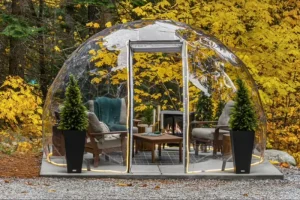
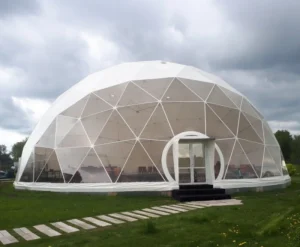
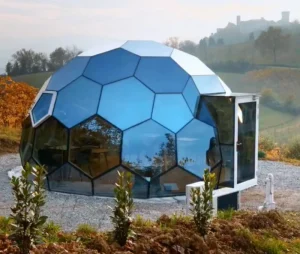
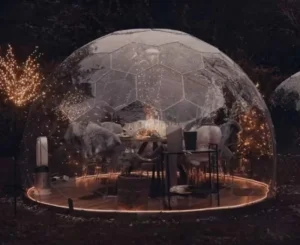
When choosing a glamping dome tent, you’ll find a wide price range on the market. Many factors influence the price, primarily including size, materials, craftsmanship, and brand.
For example, a standard 6-meter diameter glamping dome tent can range in price from $2,000 to several thousand dollars; while a larger 10-12 meter tent could cost $10,000 to over $20,000.
Therefore, choosing the right size and materials helps control your budget. Below, we’ll analyze these influencing factors and their corresponding price ranges in detail.
Size and Capacity
Size is one of the most direct factors affecting the glamping dome tent price, as every 1–2 meter increase in diameter significantly increases the amount of steel used, the area of the outer membrane, shipping volume, and installation difficulty.
For example, a 6m diameter galmping dome tent price typically corresponds to an interior space of about 28 square meters, while a 10m dome tent can reach about 78 square meters—doubling the space, but potentially increasing material costs by 2–3 times. Larger sizes also result in more complex load-bearing structures and higher requirements for manufacturing processes.
Below is a comparison of common sizes and prices to help you understand the differences:
| Size | Internal Area | Capacity | Typical Use | Price Range (USD) |
|---|---|---|---|---|
| 6m Dome | 28 m² | 2–4 people | Couple’s Room / Standard Room | $2,000 – $4,500 |
| 8m Dome | 50 m² | 4–6 people | Family Room / Suite | $3,500 – $7,500 |
| 10m Dome | 78 m² | 8–12 people | Multi-person Room / Small Event Space | $6,000 – $12,000 |
| 12m Dome | 113 m² | 15–20 people | Dining Room / Party Room / Reception Hall | $9,000 – $18,000 |
Larger glamping dome tent not only require more expensive materials, but also place higher demands on structural strength, wind resistance, and foundation securing methods. Therefore, larger dome tents often drive up the overall budget.
Material Quality and Specifications
Materials are the second most crucial factor influencing the glamping dome tent price, as they directly determine the tent’s lifespan, wind resistance, insulation performance, and overall safety.
Frame Material Differences
Frames are generally made of galvanized steel (Q235) or aluminum alloy (6061-T6).
- Q235 Galvanized Steel: High cost-performance ratio, strong load-bearing capacity, but heavier.
- 6061-T6 Aluminum Alloy: Lighter weight, stronger corrosion resistance, suitable for coastal and humid climates, but approximately 20-40% more expensive than steel structures.
Outer Membrane Material Differences (PVC vs PVDF vs ETFE)
Differences in outer membrane materials also significantly impact price:
Standard PVC (650gsm): Suitable for general guesthouses, high cost-performance ratio, but average insulation performance.
High-Strength PVC (850gsm–950gsm): Higher durability and tensile strength, commonly used in commercial campsites or areas with strong winds.
PVDF membrane material: Offers stronger UV resistance and better self-cleaning properties, but is typically about 30% more expensive than PVC.
Frame thickness and connection methods also affect the glamping dome tent cost. For example, upgrading from 2.0mm to 2.5mm wall thickness and using industrial-grade bolts instead of ordinary fasteners improves overall safety, but also increases cost. If the campsite is located in an area with wind speeds exceeding 120 km/h, a specially reinforced structure is usually required, which significantly increases the price.

Design & Customization
Higher levels of customization result in higher design fees and production costs. Basic glamping dome tents typically include only the structure, outer membrane, door, and a few windows, while high-end campsites incorporate panoramic transparent windows, glass doors, skylights, shading systems, and two-tone membrane materials, among other personalized designs. These items often account for 10%–30% of the overall cost.
In addition, there are more in-depth customization options, such as:
- Structural color painting (white, black, desert blue)
- External brand logo UV printing
- Thickened insulation, essential for winter areas
- Interior ceiling and lighting wiring pre-installed
- Three-layer reinforced design (for extremely cold regions)
The more customization, the longer the factory’s production cycle. Basic models typically take 7–10 days to produce, while customized models may extend to 20–30 days.
A basic 6m glamping dome tent might only cost $2,000–$3,000. A high-end 6m dome with a transparent window, insulation, and glass door can rise to $4,500–$6,000.
For resorts or large campgrounds, while customization is more expensive, it significantly enhances the stay experience, thereby increasing room rates and ultimately translating into long-term revenue.
Accessories & Interior Facilities
Accessories and interior facilities often determine the tent’s “comfort,” that is, whether guests are willing to pay for them. Basic tents only provide the external structure, while a true glamping experience requires much more. For example: Wooden platform: Costs can range from several hundred to several thousand dollars, depending on the ground conditions.
Insulation: Typically an 8–12 cm thick layer of cotton, enhancing the winter comfort; larger tents are more expensive.
Air conditioning and heating systems: Prices range from $300 to $1,000, depending on wattage.
Solar power and smart lighting: Costs increase the further the campsite is from mains power.
If fully furnished (bed, sofa, pendant lights, rug, vanity, etc.), the total cost of the furnishings can even exceed the tent’s price. Many campsite reports indicate that the total investment in a fully furnished single-unit dome tent is approximately 1.5–3 times the cost of the tent structure, depending on location and level of luxury.
Brand, Manufacturer & Location
Brand awareness and factory strength also significantly impact price. Factories with years of export experience and CE/ISO certifications typically have more sophisticated engineering design, wind resistance testing, and quality control systems, resulting in prices 10-25% higher for the same specifications compared to smaller factories. However, high-quality manufacturers offer longer product lifespans and more stable after-sales service, making them a more worthwhile long-term investment.
The manufacturer’s location also affects the glamping dome tent prices. For example: Chinese factories: possess strong large-scale production capabilities, and are generally considered by global customers to offer better value for money.
European and American manufacturers: have higher labor costs, resulting in product prices that are typically 2-4 times higher, but with shorter logistics times.
Middle Eastern and Southeast Asian factories: offer moderate prices, but their structural and membrane material grades are not as high as those of established Chinese or European and American manufacturers.
Shipping costs cannot be ignored. A 6-10 meter dome tent typically occupies 1-3 cubic meters; additional budget should be allocated for remote islands or intercontinental transport.
Brand influence determines service experience, while regional differences determine logistics and procurement cycles, ultimately impacting the overall price.

Gaxdome products:Why are they the first choice for many campsites?
Gaxdome, a leading Chinese manufacturer of dome tents, has long provided reliable dome structure solutions for campsites, boutique guesthouses, and scenic resorts worldwide. With its stable engineering quality and flexible customization capabilities, Gaxdome products maintain a high usage rate in various high-end camping projects.
Gaxdome’s core advantages include:
- Aluminum alloy or high-strength structural steel frames, ensuring safety, stability, and long service life.
- High-density PVC/PVDF membrane material, tested for fire resistance, weather resistance, and UV protection, making it more suitable for long-term outdoor operation.
- Comprehensive customization capabilities, offering options such as transparent windows, insulation layers, glass doors, and windproof reinforcement.
- Mature international export experience, simplifying packaging, transportation, and on-site installation guidance.
- Factory direct supply and wholesale advantages, suitable for new campsites or multiple purchases.
For those looking to create more competitive and experiential high-end camping projects, Gaxdome’s glamping dome tents not only offer cost advantages but also provide more reliable quality assurance, achieving a better balance between initial investment and long-term operation.
FAQ about Galmping dome tent
1. How long does a Glamping Dome Tent last?
With proper maintenance, a high-quality dome typically lasts 8–15 years. PVC membranes last approximately 5–8 years, while PVDF can last over 10 years.
2. How much wind can a dome tent withstand?
General commercial-grade domes can withstand wind speeds of 80–120 km/h, sufficient for most typical camping scenarios. The reinforced version of the Gaxdome can withstand 120–130 km/h, suitable for areas with stronger winds and more extreme weather, such as:
- Islands and coastal areas (e.g., the Philippine Islands, California coastline)
- Windy high-altitude areas (e.g., the Colorado Highlands, the Qaidam Basin in Qinghai)
- Seasonally windy areas (e.g., the Mongolian steppes, the Argentine Patagonia region)
These areas are frequently affected by strong winds; choosing a high-strength structure significantly improves the tent’s safety and durability, reducing operational risks in extreme weather.
3. Can a dome tent be used in winter?
Dome tents can be used in winter. Using an 8–12mm thick insulation layer and a 2–4 kW heater or air conditioning system, the indoor temperature can typically be 15–25°C higher than the outdoor temperature. In environments as low as -10°C to -20°C, a properly insulated dome tent can still provide a comfortable stay.
4. Can I set up a dome tent myself?
Dome tents can be set up by oneself. Small domes of 6–8 meters can be erected by two or three people. For larger structures over 10 meters, it is more suitable to have a professional team install them to ensure structural stability and greater safety.
5. Are glamping dome tents easy to transport?
The overall structure of a dome tent is detachable, making it relatively easy to transport. Tents of different diameters vary significantly in volume when folded and packed. Most common 6–10m commercial-grade domes can be kept within the 1–3 m³ range, making international shipping (sea/land) relatively cost-effective.
Conclusion
Choosing the right Glamping Dome Tent involves more than just price; it requires consideration of size, materials, customization, accessory configuration, and the brand and supplier. Understanding these key factors will help you find the optimal balance between budget and functionality. Whether it’s a small couples’ campsite or a large commercial camping project, planning the size, materials, and equipment configuration in advance will make your investment more efficient and your user experience more comfortable.
If you want to choose a cost-effective, durable, and safe dome tent for your project, the full customization and design services offered by professional manufacturers will be an important guarantee for the success of your campsite.
If you want to provide a unique and comfortable Glamping experience for your campsite or guesthouse, choosing a cost-effective, durable, and safe dome tent is crucial. Gaxdome offers a full range of dome tents from 5 to 12 meters, supporting wholesale purchasing and complete customization services to meet diverse needs, whether for outdoor accommodations, event spaces, or commercial campsites.
- Free project planning and design advice provided.
- Structures can be customized according to wind and snow load requirements.
- Fast delivery and global shipping supported.
- Factory direct pricing, suitable for large-scale campsite expansion.
Contact us to get a personalized quote and 3D Dome design to quickly bring your camping project to life and make it stand out.